
TL;DR: Shekhawati is a cluster of small towns in north-eastern Rajasthan, spread across the Jhunjhunu, Sikar, and Churu districts. Together they hold over 2,000 painted havelis built by Marwari merchants between the 18th and early 20th centuries. The main towns worth visiting are Nawalgarh, Fatehpur, Mandawa, Ramgarh, Mahansar, Dundlod, Jhunjhunu, and Mukundgarh. October to March is the best window. A 3-day circuit covers the essentials comfortably.
Most people who visit Rajasthan go to Jaipur, Udaipur, or Jodhpur. They see forts, palaces, and lake views. All worth the trip. But if you ask someone who’s been to Shekhawati what surprised them most, they’ll probably mention the walls.
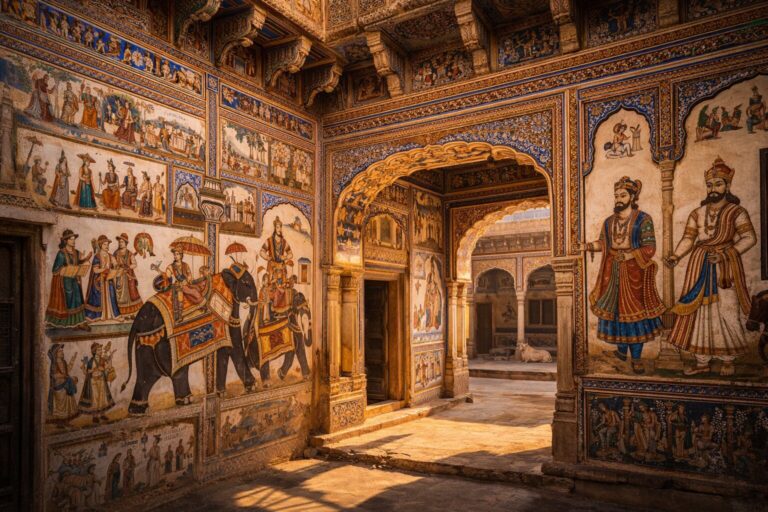
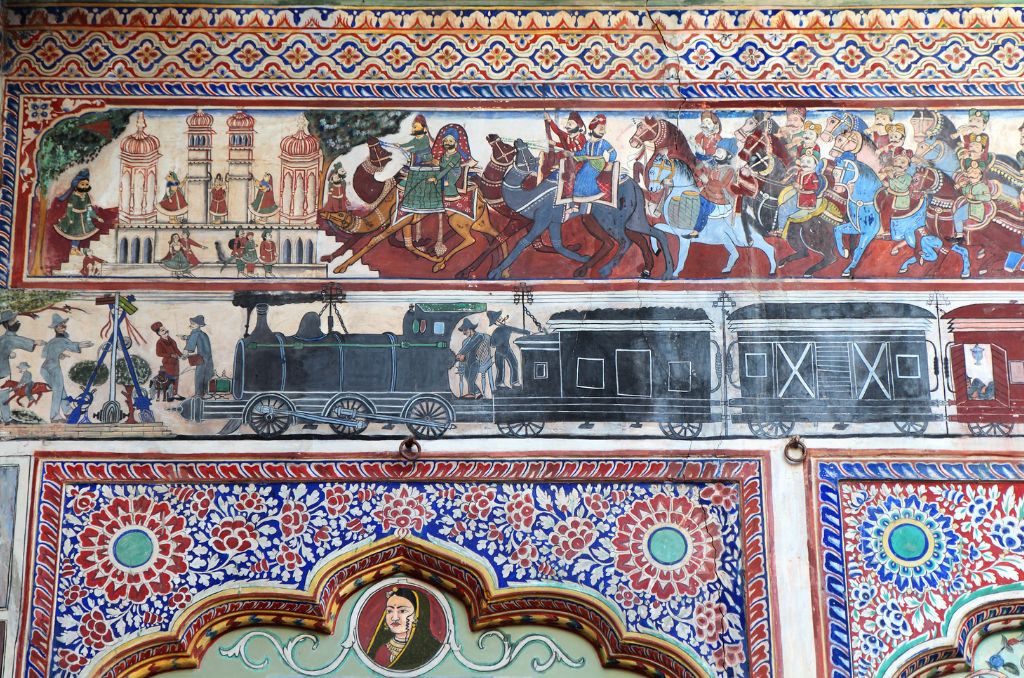
In Shekhawati, over 2,000 havelis are covered in painted frescoes, inside and out. Hindu gods sit beside steam engines. British officers in top hats share wall space with Krishna playing his flute. Camels, ships, gramophones, and Queen Victoria all turn up on the same building. The art isn’t in a museum. It lines the streets of half a dozen small towns scattered across a semi-desert landscape between Delhi, Jaipur, and Bikaner.
Here’s a practical guide to the towns worth your time, what to see in each, and how to put a trip together.
Why Is Shekhawati Called an Open-Air Art Gallery?
The name gets used a lot, but in Shekhawati’s case it’s accurate. The art here isn’t confined to palaces or temples. Entire streets, entire neighbourhoods, are covered in painted mansions. The frescoes appear on exterior walls visible from the road, on interior courtyards, on ceilings, pillars, and even above shopfronts.
This happened because of money and competition. Between the 18th and 19th centuries, Shekhawati sat on major caravan trade routes connecting inland India to Gujarat’s ports. Local rulers kept taxes low, and Marwari merchant families settled in towns like Nawalgarh, Fatehpur, and Ramgarh, growing wealthy on trade in salt, cotton, opium, and spices.
These families poured their profits into grand havelis and commissioned artisans to paint them floor to ceiling. Neighbours competed to build the most impressive home. The result, accumulated over about 150 years, is one of the largest concentrations of domestic fresco art anywhere in the world.
Nawalgarh: The Artistic Heart of Shekhawati
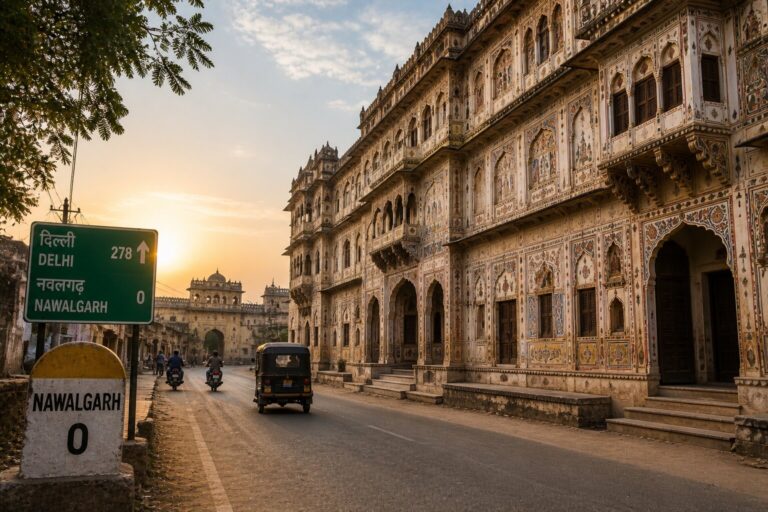
If you can only visit one town, make it Nawalgarh. It has nearly 200 fresco-adorned havelis, the highest concentration in the region, and the best-preserved examples are open as museums.
Podar Haveli Museum is the headline attraction. Built in 1902, it contains over 750 frescoes covering 11,200 square metres, with 19 thematic galleries displaying Rajasthani turbans, jewellery, musical instruments, and bridal costumes. Plan 90 minutes minimum.
Morarka Haveli is a five-minute walk away. Less restored, more raw. The frescoes here are in rich indigo blue and red tones, and the haveli has an unusual detail: two portraits of Jesus Christ, one inside and one outside, a rarity in Shekhawati.
Aath Haveli Complex, a cluster of eight interconnected havelis, is quieter and less touristy. Good for seeing fresco art in a more intimate setting.
Beyond the museums, Nawalgarh’s old bazaar streets are lined with unrestored havelis whose faded frescoes you can see from the road. Nobody charges admission. You just look up.
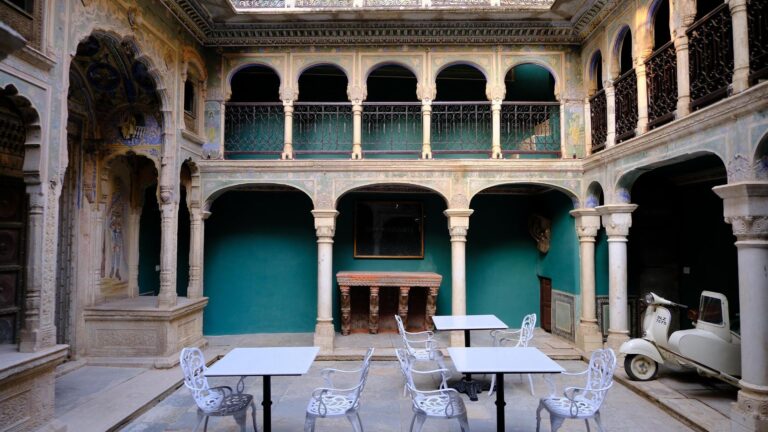
For the most immersive experience, stay inside a restored haveli. Vivaana Museum Hotel occupies the Jaipuria Haveli in the heart of town, with an on-site museum, rooftop pool, and rooms surrounded by original frescoes.
Fatehpur: Where a French Artist Saved a Haveli
Fatehpur sits on the Jaipur-Bikaner highway, which makes it one of the easier Shekhawati towns to reach. Founded in the early 16th century, it became a prosperous trading centre and still holds dozens of painted havelis and temples.
The standout attraction is the Nadine Le Prince Haveli. Originally the Nand Lal Devra Haveli (built in 1802), it was purchased in 1998 by French artist Nadine Le Prince, who spent years restoring the frescoes using traditional techniques. Today it operates as a cultural centre with guided tours, a gallery mixing Indian and French contemporary art, and a few guest rooms. It’s arguably the most meticulously restored haveli in all of Shekhawati.
Other stops in Fatehpur: the Dwarkadheesh Temple, built in the 19th century by Seth Asharam Ji Poddar with detailed murals, and the Singhania Haveli (1857-1860), known for its fresco scenes of the British Raj.
Fatehpur is rougher around the edges than Nawalgarh or Mandawa. The town itself is congested, and most havelis beyond the Le Prince are unrestored. But if you’re interested in conservation work and the intersection of Indian and European fresco traditions, it’s a necessary stop.
What Makes Mandawa a Good Starting Point?
Mandawa has the best tourism infrastructure in Shekhawati, which is why many visitors start here. It’s about 250 km from Delhi (roughly 5-6 hours by road) and has more hotel options than any other town in the region.
The town’s main draw is Mandawa Fort, built in 1755 by Thakur Nawal Singh and now operating as a heritage hotel. The fort blends Rajput and Mughal architectural elements and is worth visiting even if you’re not staying there.
Mandawa’s streets are lined with painted havelis, though fewer are formally open to visitors compared to Nawalgarh. The Murmuria Haveli (1930s) is notable for its fusion of Rajasthani and European imagery, with Radha-Krishna appearing alongside George V, Jawaharlal Nehru, and Venetian gondolas on the same walls.
Just 8 km from Nawalgarh, Vivaana Culture Hotel in nearby Mandawa offers a heritage stay inside Churi Ajitgarh, a 150-year-old twin haveli with original frescoes and curated cultural experiences.
Stay in Shekhawati
Two Havelis, Two Towns, One Journey
Two restored 19th-century havelis. One unforgettable journey through Shekhawati.
Nawalgarh
Vivaana Museum Hotel
Jaipuria Haveli, Nawalgarh
A beautifully restored haveli in the heart of town. Home to the Shekha Museum, rooftop pool, and authentic Rajasthani dining.
Mandawa
Vivaana Culture Hotel
Churi Ajitgarh, Mandawa
A 150-year-old twin haveli with original frescoes, curated cultural experiences, and the warmth of Shekhawati hospitality.
Ramgarh: The Largest Fresco Collection in Shekhawati
Also known as Ramgarh Sethan (“Ramgarh of the wealthy merchants”), this town was developed in the late 18th and 19th centuries by families like the Poddars, Ruias, and Sawalkas. They poured money into havelis, temples, and cenotaphs, and the town ended up with what some accounts call the largest number of frescoes in Shekhawati.
The standout attraction is the Shani Temple, built by the Khemka family in 1840. From outside it looks dilapidated, but the interior is covered in rich murals and extravagant Belgian glass mirror work that catches even the faintest light.
Ramgarh’s havelis tend to be less visited than Nawalgarh’s, which has an upside: you’ll often have the spaces to yourself. The Sawalka Haveli, built just outside the city gates after a family feud kept its owners out of the town centre, is one of the most dramatic buildings in the region.
Worth noting: Ramgarh has fewer tourist facilities than Mandawa or Nawalgarh. It’s best visited as a day stop on a Shekhawati circuit rather than as a base.
The Smaller Towns That Reward a Detour
The main circuit of Nawalgarh, Mandawa, and Fatehpur covers the essentials. But if you have a third or fourth day, these smaller towns add real depth.
Mahansar is 30 minutes north of Mandawa and worth the drive for one building alone: Sone Chandi ki Dukan (literally “the gold and silver shop”), built in 1846. The frescoes here incorporate real gold and silver leaf, along with fragments of semi-precious stones. The three vaulted ceilings depict scenes from the Ramayana, incarnations of Vishnu, and the life of Krishna. The whole room glows. You’ll need to ask for the key at the nearby Raghunath Temple shop. Entry is 100 rupees.
Dundlod is a quieter village about 8 km from Nawalgarh. Its main attraction is Dundlod Fort, built in 1750, which now operates as a heritage hotel with stables of Marwari horses. The Goenka Haveli nearby has been converted into a small museum with well-preserved frescoes. Dundlod is the right choice if you want a peaceful base away from the busier towns.
Jhunjhunu is the district headquarters and the largest town in the region. It’s more urban and less quaint than the smaller settlements, but it has some noteworthy sites: Khetri Mahal (a wind palace with no exterior walls on its upper floors, sometimes compared to Jaipur’s Hawa Mahal), the Rani Sati Temple, and several fresco-painted havelis in the old town.
Mukundgarh has a restored fort and a handful of painted havelis in a setting that sees very few tourists. Good for slow travel and anyone who’s already covered the main towns.
When Should You Visit Shekhawati?
October to March. This is not optional advice; it’s the difference between an enjoyable trip and an uncomfortable one. Shekhawati sits in a semi-desert zone, and summer temperatures regularly exceed 45°C. Winter days are clear and mild (15-25°C), perfect for the amount of walking that fresco-hunting requires.
February is particularly good if you can time it with the annual Shekhawati Festival, which brings guided heritage tours, handicraft exhibitions, and cultural performances to Nawalgarh and surrounding towns.
For photography, early morning light (between 7 and 9 AM) is the best window. The polished arayish plaster on many frescoes catches angled light in a way that gives the paintings a subtle sheen, which flat midday sun washes out completely.
How to Plan a Shekhawati Trip
A 2-3 day circuit is enough to see the highlights. Here’s a practical framework.
Day 1: Arrive in Mandawa (5-6 hours from Delhi, 3-4 hours from Jaipur). Explore Mandawa Fort and the town’s havelis in the afternoon. Stay overnight in Mandawa.
Day 2: Drive to Nawalgarh (30 minutes). Spend the morning at Podar Haveli Museum and Morarka Haveli. Walk the old bazaar after lunch. If time allows, visit the Aath Haveli Complex. Stay overnight in Nawalgarh.
Day 3: Visit Fatehpur (1 hour from Nawalgarh) for the Nadine Le Prince Haveli and Dwarkadheesh Temple. If you have time, detour to Mahansar for the Sone Chandi ki Dukan on the way. Return to Delhi or Jaipur.
If you have a fourth day, add Ramgarh and Dundlod to the loop.
A few practical notes: hire a local guide if you can, because most fresco stories (especially the mythological references) aren’t labelled. Carry cash; smaller towns have limited card acceptance. Start early each day to make the most of morning light and avoid midday heat. And stay in a heritage haveli if possible. Sleeping inside these buildings is a fundamentally different experience from visiting them as a day tourist.
Beyond the Usual Rajasthan Circuit
Shekhawati doesn’t compete with Jaipur’s forts or Udaipur’s lakes. It offers something else entirely: a quieter, more intimate kind of heritage experience.
There are no crowds. No queues for tickets. No audio guides. You walk through streets that look much the way they did a century ago, and the art is right there, on the building beside the grain shop, above the door of the house where someone still lives, on the ceiling of a room that hasn’t been entered in decades.
The region is still underseen relative to what it holds. That’s part of the appeal, and also part of the urgency. Many havelis are in advanced decay. The ones that have been restored, like Vivaana’s heritage properties in Nawalgarh and Mandawa, or the Nadine Le Prince Haveli in Fatehpur, show what’s possible. But they represent a fraction of the 2,000-plus painted buildings in the region.
If you’re going to go, go soon. And give it more than a day. Shekhawati deserves that.
Stay in Shekhawati
Two Havelis, Two Towns, One Journey
Two restored 19th-century havelis. One unforgettable journey through Shekhawati.
Nawalgarh
Vivaana Museum Hotel
Jaipuria Haveli, Nawalgarh
A beautifully restored haveli in the heart of town. Home to the Shekha Museum, rooftop pool, and authentic Rajasthani dining.
Mandawa
Vivaana Culture Hotel
Churi Ajitgarh, Mandawa
A 150-year-old twin haveli with original frescoes, curated cultural experiences, and the warmth of Shekhawati hospitality.
Frequently Asked Questions
How many days do you need to explore Shekhawati?
Two to three days covers the main towns comfortably. A typical circuit includes Mandawa, Nawalgarh, and Fatehpur. If you add Ramgarh, Mahansar, and Dundlod, plan for four days. Nawalgarh and Mandawa make the best overnight bases.
What is the best time to visit Shekhawati Rajasthan?
October to March. Winter days are clear and mild (15-25°C), ideal for the walking that fresco-hunting requires. Summer temperatures in Shekhawati regularly exceed 45°C and make outdoor sightseeing impractical. The annual Shekhawati Festival in February adds guided tours and cultural events.
Which Shekhawati town has the most painted havelis?
Nawalgarh has nearly 200 fresco-adorned havelis, one of the highest concentrations in the region. Ramgarh is also notable for its sheer number of frescoes, though fewer of its havelis are formally open to visitors.
Can you stay inside a heritage haveli in Shekhawati?
Yes. Several havelis have been restored into heritage hotels. Vivaana Museum Hotel in Nawalgarh and Vivaana Culture Hotel in Mandawa are two restored 19th-century havelis with original frescoes, modern rooms, and curated cultural experiences. The Nadine Le Prince Haveli in Fatehpur and Castle Mandawa also offer heritage accommodation.
How do you reach Shekhawati from Delhi or Jaipur?
From Delhi, Mandawa is about 250 km (5-6 hours by road). From Jaipur, Nawalgarh is roughly 180 km (3-4 hours). Nawalgarh has a railway station on the Sikar-Loharu line with connections to Jaipur and Sikar. The nearest airport is Jaipur International. Most visitors hire a car and driver for the flexibility to cover multiple towns.