
TL;DR: Most travellers see only a fraction of Rajasthan. Beyond Jaipur and Udaipur lies a quieter, more soulful side of the state, where painted havelis, leopard-spotted hills, ancient stepwells, and abandoned villages wait with almost no crowds. This guide covers 15 hidden places in Rajasthan worth slowing down for. For travellers exploring Shekhawati, Vivaana’s heritage hotels in Mandawa and Nawalgarh make the ideal base.
Rajasthan is one of India’s most visited states. In 2024, it welcomed over 23 crore domestic tourists, a figure that grows year on year. And yet, nearly all of that footfall is concentrated in just four or five cities.
Step beyond those cities, and the state transforms. The noise fades. The streets empty. What remains is something rarer: Rajasthan at its most honest, most beautiful, and most unhurried.
These 15 hidden places offer exactly that. Each one carries its own story, its own texture, and its own quiet invitation to stay a little longer.
What Makes Rajasthan’s Offbeat Places Worth the Detour?
Rajasthan’s lesser-known destinations offer something its famous cities often can’t: space to actually experience the place. No queues at the gate, no tour groups blocking the view, no rush to move on. You walk through frescoed lanes at your own pace, sit by a lake with no one else around, and share a conversation with a local guide who has the time to tell you the full story.
These destinations aren’t underdeveloped. Many have beautifully restored heritage stays, well-preserved monuments, and rich cultural traditions. They simply haven’t been discovered by mass tourism yet. That’s precisely what makes them worth visiting now.
The 15 places in this guide span the full range of Rajasthan’s geography and character: painted merchant towns in Shekhawati, silent desert dunes near Jaisalmer, marble temples in the Aravallis, and green river valleys in the far south.
Shekhawati: Rajasthan’s Living Open-Air Art Gallery
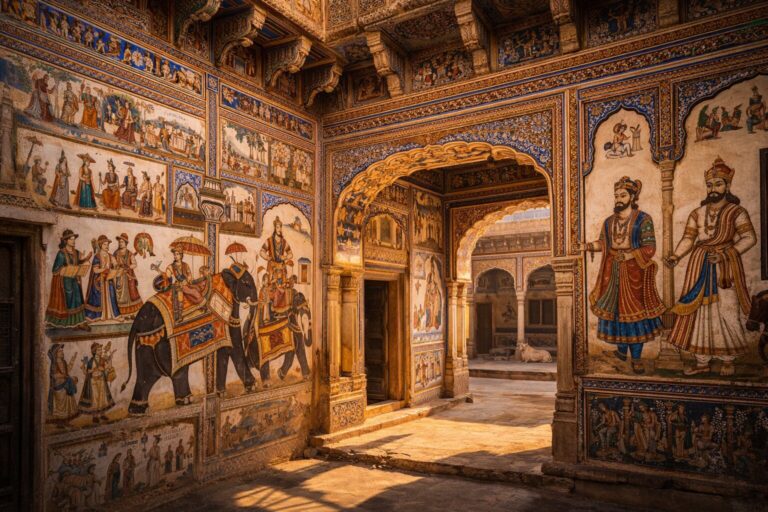
Shekhawati is one of Rajasthan’s most extraordinary regions and one of its most overlooked. It’s a cluster of small towns in north-east Rajasthan, roughly between Delhi, Jaipur, and Bikaner, where wealthy Marwari merchants once built grand havelis (mansions) and covered them, inside and out, in vivid frescoes.
The result is a region that functions as an open-air art gallery, stretching across dozens of towns. The paintings depict everything from Hindu mythology and royal portraits to steam trains and British officers, reflecting centuries of changing influences. Local artisans called chiteras created these frescoes using natural pigments: indigo, saffron, red stone, and limestone. Many of those colours remain vibrant today.
Mandawa is the most accessible entry point. Around 170 km from Jaipur, it’s a small town filled with painted havelis in various states of preservation. Walking its lanes in the early morning, before the day heats up, is one of the most quietly spectacular experiences Rajasthan offers.
Nawalgarh, a short drive away, is considered by many heritage travellers to have the finest frescoes in the region. Its Podar Haveli Museum alone is worth an afternoon. The town feels lived-in and warm, with local families still occupying some of the older properties around the bazaar.
Mahansar, a smaller village nearby, is known for its Sone Chandi ki Dukan (the shop of gold and silver), a haveli whose interiors are painted with rare gold-leaf frescoes on mythological and royal themes. It sees very few visitors, which makes the experience feel almost private.
Alsisar, also within the Shekhawati circuit, offers beautifully restored haveli stays and a slower pace still. It’s ideal for travellers who want heritage without even the modest crowds of Mandawa.
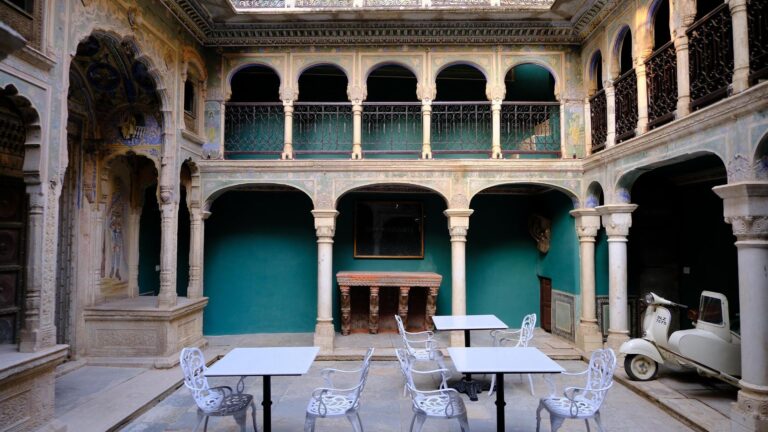
For those making Shekhawati the heart of their Rajasthan journey, Vivaana Culture Hotel in Mandawa offers a stay inside a restored 150-year-old twin haveli, with original frescoes, carved courtyards, and curated cultural experiences. In Nawalgarh, Vivaana Museum Hotel sits in the Jaipuria Haveli at the heart of the town, giving guests direct access to its painted streets and haveli museums.
Into the Desert: Khuri, Barmer, and Kuldhara
Not all desert travel in Rajasthan needs to run through Jaisalmer’s Sam Sand Dunes. Three quieter alternatives offer the same vast, golden landscape with a fraction of the footfall.
Khuri is a small village around 40 km from Jaisalmer, nestled among the dunes of the Thar Desert. Camel safaris here feel genuinely unhurried. In the evenings, traditional folk performances take place under open skies, with no stage lighting and no ticketed crowds. It’s desert travel as it’s meant to feel.
Barmer, further south, is one of Rajasthan’s least explored districts and one of its most culturally rich. It’s known for hand-block printing, intricate embroidery, folk music traditions, and festivals like the Thar Festival. The town’s Kiradu Temples, built in the 11th century, add a layer of ancient history to the visit.
Kuldhara, near Jaisalmer, offers something entirely different. It’s an abandoned village, deserted overnight centuries ago by the Paliwal Brahmin community under circumstances that remain the subject of local legend. Walking through its silent stone lanes, past collapsed doorways and empty courtyards, is haunting and strangely moving. It speaks to a side of Rajasthan’s history that the palace circuit rarely touches.
Which Historic Towns in Rajasthan Can You Visit Without the Tourist Rush?
Bundi, Kuchaman, and Jhalawar are three of Rajasthan’s most rewarding historic towns for travellers seeking heritage without crowds. Bundi, tucked into a valley near Kota, has over 50 baoris (stepwells) within its limits, an ornate palace, Taragarh Fort overlooking the old town, and blue-painted lanes that echo Jodhpur without any of Jodhpur’s tourism pressure. It’s consistently praised by travellers as one of the most beautiful towns they’d never heard of.
Kuchaman, in the Nagaur district, centres on a hilltop fort that has been carefully converted into a heritage hotel. The fort itself is over a thousand years old and offers panoramic views across the plains. The town below has old temples, bazaars, and havelis that reward slow, on-foot exploration.
Jhalawar, in Rajasthan’s far south, surprises most visitors immediately. Unlike the arid landscapes of the west, it’s lush and green, fed by rivers and ringed by forests. It has Buddhist cave paintings, a medieval fort, and a quiet pace of life that feels entirely removed from the Rajasthan of popular imagination.
Wildlife, Marble, and Wilderness: Jawai, Ranakpur, and Kumbhalgarh
These three destinations speak to Rajasthan’s natural and architectural grandeur, each in a completely different register.
Jawai, in the Pali district, is one of India’s most unusual wildlife destinations. Leopards live among the area’s granite hills and rocky outcrops, sharing space with local pastoral communities in a way that has few parallels elsewhere in the country. Unlike traditional jungle safaris, Jawai offers open-landscape sightings where the animals move freely across a wide terrain. Luxury tented camps have made the area more accessible without diminishing its wild quality.
Ranakpur is home to one of the most intricate Jain temples in India. The Chaturmukha Dharana Vihara, set among the Aravalli hills, contains 1,444 uniquely carved marble pillars, no two of which are identical. The temple dates to the 15th century and took decades to complete. Surrounded by forest and near-silence on most days, it’s a place that rewards quiet contemplation as much as architectural admiration.
Kumbhalgarh holds a remarkable distinction. Its fort wall stretches for 36 kilometres across the Aravalli hills, making it the second longest wall in the world after the Great Wall of China. The fort itself is a UNESCO World Heritage Site, part of the Hill Forts of Rajasthan group. It was also the birthplace of Maharana Pratap, one of Rajasthan’s most celebrated rulers. The surrounding wildlife sanctuary shelters leopards, wolves, sloth bears, and a variety of birds, making the landscape as compelling as the history.
What Are Rajasthan’s Most Stunning Hidden Architectural Sites?
Three destinations in this list deserve special attention for the quality and distinctiveness of their built heritage.
Dungarpur, in southern Rajasthan, is a town of lakes and green marble palaces that most travellers walk straight past on the way elsewhere. The Juna Mahal, a 13th-century fort-palace, is covered in mirror-work, miniature paintings, and carved stone. The surrounding landscape, with its reservoirs and tree cover, feels more like Kerala than Rajasthan.
Narlai, a village in the Pali district, offers a refined rural experience centred on its ancient temples, a prominent granite rock formation, and beautifully restored heritage properties. Stepwell dining under the stars has become one of its signature experiences: a long table lit by oil lamps, set inside a centuries-old baoli (stepwell), with the night sky above and the stone walls around you.
Chand Baori in Abhaneri, near Dausa, is one of the most geometrically striking structures in all of India. The stepwell descends thirteen storeys below ground level, with 3,500 narrow steps arranged in perfect symmetry on three sides. It was built in the 9th century and is maintained by the Archaeological Survey of India as a protected monument. It remains relatively uncrowded, which means you can stand at the edge and simply absorb its scale without distraction.
When to Visit and How to Plan Your Offbeat Rajasthan Trip
The best time to travel to these destinations is between October and March. Temperatures are pleasant across the state, the light is ideal for walking and photography, and the roads are at their most manageable.
Carry enough cash before heading to smaller towns. ATMs are sparse in places like Khuri, Narlai, and Mahansar. Plan your itinerary with extra time at each stop. Offbeat Rajasthan rewards slow travel. A circuit that tries to cover all 15 places in five days will miss the point entirely. Hire a local guide wherever possible. At sites like Chand Baori and Kuldhara, a knowledgeable guide adds layers of history and context that no guidebook can replicate. Dress modestly in rural areas and at religious sites. Respect for local customs makes a real difference to the quality of interaction you’ll have with the communities you visit.
For travellers making Shekhawati the base of their journey, which positions you well for day trips across much of this list, Vivaana Culture Hotel in Mandawa and Vivaana Museum Hotel in Nawalgarh offer heritage stays that are themselves part of the experience. Both are restored 19th-century havelis with original frescoes, thoughtful interiors, and the kind of warm, unhurried hospitality that suits this style of travel perfectly.
The Quiet Side of Rajasthan Is Worth Finding
Rajasthan’s famous cities are magnificent. But the state’s quieter places carry a different kind of beauty: one that takes its time, doesn’t announce itself, and stays with you long after the journey ends.
These 15 hidden places are an invitation to travel more slowly, more curiously, and more honestly through one of India’s greatest landscapes. The walls still whisper here. The frescoes still hold their colour. And the roads that lead to them are largely empty.
Frequently Asked Questions
What are the best offbeat places to visit in Rajasthan without the crowds?
Some of the best offbeat places in Rajasthan include Bundi, Shekhawati (particularly Mandawa and Nawalgarh), Jawai, Ranakpur, Kumbhalgarh, Khuri, Narlai, and Chand Baori in Abhaneri. Each offers significant heritage, natural beauty, or cultural depth without the tourist pressure of cities like Jaipur, Jodhpur, or Udaipur. The best time to visit all of them is between October and March.
Is Shekhawati worth visiting for first-time Rajasthan travellers?
Yes, absolutely. Shekhawati is one of the most unique regions in Rajasthan and is often called the open-air art gallery of India. Its painted havelis in towns like Mandawa, Nawalgarh, and Mahansar represent a style of fresco art found almost nowhere else in the world. First-time visitors who include Shekhawati in their itinerary often say it becomes the most memorable part of their trip.
What is the best base for exploring Rajasthan’s hidden gems?
Shekhawati, particularly Mandawa or Nawalgarh, makes an excellent base for exploring northern and central Rajasthan’s offbeat destinations. Both towns are well-connected by road to Jaipur and Delhi, and their central position allows for day trips to Alsisar, Mahansar, Jhunjhunu, and Dundlod. For the western circuit, Jaisalmer is the nearest hub for Khuri and Kuldhara.
When is the best time to visit offbeat places in Rajasthan?
October to March is the ideal window for visiting Rajasthan’s lesser-known destinations. The weather is cool and comfortable, especially for walking, trekking, and outdoor exploration. Summer months (April to June) bring extreme heat, particularly in desert regions like Khuri and Barmer, and are best avoided unless you are a very experienced desert traveller.
What makes Mahansar and Alsisar different from Mandawa in Shekhawati?
Mahansar and Alsisar are smaller, quieter villages within the Shekhawati circuit that attract far fewer visitors than Mandawa. Mahansar is known specifically for its gold-leaf frescoes inside the Sone Chandi ki Dukan haveli, a style of painting that is exceptionally rare even within the region. Alsisar is better known for its boutique heritage stays and its peaceful, unhurried atmosphere. Both villages are ideal for travellers who want the Shekhawati experience without any crowds at all.