
TL;DR: The history of Shekhawati spans thousands of years — from ancient Vedic kingdoms and Rajput dynasties to a golden age of merchant wealth and fresco art in the 18th and 19th centuries. Today, the region’s painted havelis stand as one of the world’s largest open-air art galleries. Understanding this history transforms every wall you see in Mandawa, Nawalgarh, or Jhunjhunu from beautiful decoration into living story.
Walk through any lane in Mandawa at dawn and you feel it before you understand it. Children run past doorways painted with gods and elephants. A shopkeeper sits beside a wall showing Queen Victoria and Krishna on the same plaster. An old haveli leans gently into the morning light, its frescoes faded in places but still vivid enough to stop you in your tracks.
This is Shekhawati. And almost nothing about it was accidental.
The history of Shekhawati is one of the most layered stories in Rajasthan. It winds from ancient kingdoms through Rajput rebellion, Mughal alliances, extraordinary merchant wealth, a golden century of art, colonial disruption, slow decline, and a contemporary revival that is still unfolding. To visit the region without knowing this story is to see only the surface. This article takes you deeper.
Where Is Shekhawati and What Does the Name Mean?
Shekhawati is a semi-arid region in the northeastern part of Rajasthan, covering the districts of Sikar, Jhunjhunu, and Churu, with parts extending into Jaipur, Alwar, and Nagaur. It sits in the triangle between Delhi, Jaipur, and Bikaner, at the western edge of the Aravalli range and the fringes of the Thar Desert.
The name comes from Maha Rao Shekha Ji, a 15th-century Kachhwaha Rajput chieftain. “Wati” in Sanskrit means garden or land of. Shekhawati translates as “the garden of Rao Shekha.” It is a quietly proud name for a land that grew into one of India’s most remarkable cultural landscapes.
The region has no major permanent rivers. The Aravalli range forms its eastern border. Groundwater sits as deep as 200 feet in some places, and rainfall averages around 450 to 600 mm annually. In summer, hot desert winds called loo sweep the plains. Temperatures range from below zero in winter to over 50°C in peak summer. That any civilisation flourished here speaks to the ingenuity and determination of the people who built it.
Ancient Roots: The Vedic and Pre-Rajput Era
Shekhawati’s story begins long before any haveli was painted or any fort was raised.
In Vedic literature, this land was called Brahmrishi Desha in the Manusmriti and was included in “Marukantar Desha” up to the Ramayana period. During the Mahabharata era, the region was known as the Matsya Kingdom, which extended to the Sarasvati River. Dhosi Hill, which lies on the Haryana-Rajasthan border within this region, is mentioned in the Mahabharata’s Vanaparva as the site of the sage Chyavana’s ashram — and, according to tradition, the place where Chyawanprash was first formulated.
In the ancient janapada period that preceded the Maurya empire, this land was influenced by the Avanti kingdom. Historians believe the Mauryas subsequently controlled Rajasthan after defeating the Nandas of Magadha. After the Gupta dynasty collapsed, the Chauhan Rajputs held much of the Shekhawati territory. Portions of Jhunjhunu, Fatehpur, and Narhar then passed to the Kaimkhanis — a Muslim clan descended from the Chauhans whose ancestor, Karamchand, had been converted to Islam and renamed Kaimkhan by the Delhi sultan Firuz Shah Tughluq. The Kaimkhanis held this land until the Shekhawat Rajputs displaced them.
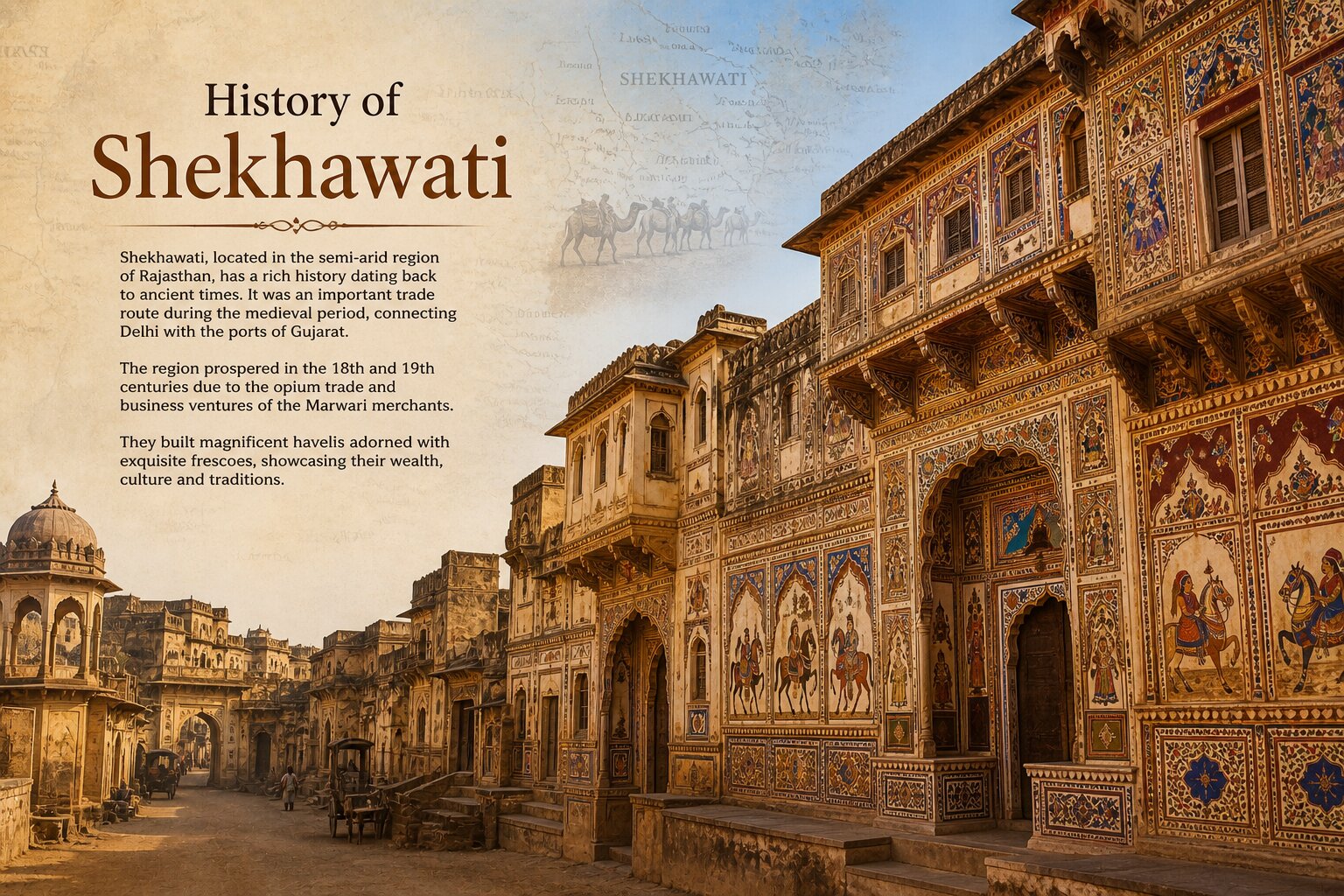
Through all these centuries, one constant remained: the trade routes. Caravans carrying spices, cotton, opium, and textiles had crossed this semi-arid corridor between inland India and the ports of Gujarat long before anyone thought to build a haveli here. That geography would later become the engine of the region’s golden age.
Rao Shekha Ji and the Birth of an Independent Kingdom
The story of the man who gave the region its name begins with an unusual origin. His father, Mokal Ji, had no son and, troubled by this, visited the Muslim saint Sheikh Burhan Chisti for blessings. A son was born to the couple. Mokal Ji named the boy Shekha, after the saint who had blessed his birth — a remarkable gesture of cross-faith gratitude that would shape the region’s identity for centuries.
Maha Rao Shekha Ji, who ruled from approximately 1433 to 1488, was a chieftain of Amarsar in the Amber territory. He grew powerful enough to challenge the Kachhwaha rulers of Amber-Jaipur, and in 1471, he did: he declared independence and proclaimed sovereignty, establishing his own principality with his capital at Amarsar. This was not a quiet retirement. It was a bold assertion of independence from the very dynasty he had served.
Rao Shekha divided his new kingdom into 33 thikanas — administrative estates — each governed by a local chief who owed loyalty to the central ruler. He built forts to protect his territory and created the governance framework that his descendants would refine for the next five hundred years. His name appears in James Tod’s foundational work on Rajasthan, in Bankidas ki Khyat (the earliest text to use the word “Shekhawati”), and was referenced in 1803 by Colonel W.S. Gardner — one of the earliest European records of the region’s name.
After Rao Shekha, his descendants spread. Sardul Singh (ruled 1730 to 1752) became one of the most consequential figures in the region’s history. In 1730, he seized Jhunjhunu. The following year, allied with the powerful Sheo Singh of Sikar, he drove out the Kaimkhani nawabs of Fatehpur. By 1732, Shekhawati had become a substantial and largely unified territory. When Sardul Singh died in 1752, his estate was divided equally among his five sons: Zorawar Singh, Kishan Singh, Akhey Singh, Nawal Singh, and Keshri Singh. Jhunjhunu became the Panchpana — the five estates. Nawal Singh inherited Nawalgarh and Mandawa. Keshri Singh took Bissau and Dundlod. Kishan Singh received Khetri and Alsisar.
These towns — Mandawa, Nawalgarh, Jhunjhunu, Khetri, Dundlod — are the same towns that carry Shekhawati’s heritage most visibly today. Every fresco you see in Mandawa traces its roots, in part, to this moment of inheritance.
Stay Where History Lives
Experience Shekhawati from Within a Heritage Haveli
Vivaana’s restored havelis in Mandawa and Nawalgarh place you inside the very history this article describes. Original frescoes, curated experiences, and the warmth of Shekhawati hospitality await.
Mandawa
Vivaana Culture Hotel
A 150-year-old twin haveli with original frescoes in the heart of Shekhawati’s most storied town.
Nawalgarh
Vivaana Museum Hotel
A beautifully restored haveli home to the Shekha Museum, rooftop pool, and Rajasthani dining.
The Mughal Period: Alliance, Art, and Influence
During the reign of Akbar, many Rajput rulers chose alliance with the Mughal Empire over conflict. The Shekhawat chieftains followed this path — and it shaped their culture in ways still visible on the walls of their descendants’ havelis.
These alliances brought stability and access to the Mughal court. Mughal influence began flowing into Shekhawati’s art and architecture: arched gateways, detailed geometric borders, floral patterns, and the concept of the painted interior room — all trace their lineage to the Mughal courts at Agra and Fatehpur Sikri, filtered through the painted monuments at Amber. The earliest Shekhawati fresco work, known as the “Jaipur fresco” style, employed techniques and craftsmen directly connected to Mughal patronage.
As the Mughal Empire weakened after the death of Aurangzeb in 1707, the Shekhawat chieftains who had spread themselves through the region began to assert greater independence. By the 1730s, they had reclaimed the full territory from the Kaimkhanis and were building their own forts and palaces — now increasingly ornamented with murals that announced their ambition and prosperity. The fresco tradition that would define Shekhawati was taking root.
The Golden Age: How Shekhawati Became One of India’s Richest Regions
The transformation that made Shekhawati famous happened because of a tax decision.
In the mid-18th century, the rulers of Jaipur and Bikaner both fell into financial difficulty and began imposing heavy taxes on the traders passing through their territories. The Thakurs of Shekhawati saw an opportunity. They significantly reduced their own duties, actively encouraging Marwari banias (traders) to settle in their towns. Almost overnight, trade caravans rerouted through Shekhawati. For over 50 years, roughly 1740 to 1800, Shekhawati became one of the richest provinces in all of India.
The goods that passed through were extraordinary in variety. Salt, opium, cotton, wool, spices, and sugar moved along the caravan routes connecting inland India to the ports of Gujarat on the Arabian Sea. Mandawa, Nawalgarh, Fatehpur, Ramgarh, and Jhunjhunu grew into prosperous market towns. The merchant families who settled here — the Poddars, Goenkas, Kotharis, Singhania, Bajaj, and Modi clans — accumulated fortunes that rivalled those of the great trading houses of Calcutta and Bombay.
These families were Marwaris: the collective term for the business communities of the Marwar region. They were known across India for their sharp financial instincts, joint-family business structures, and strong networks. They financed kings, built banks, and controlled trade routes. And when they grew wealthy enough, they came home and built.
The Architecture of Ambition: Havelis, Forts, Chhatris, and Stepwells
There is something extraordinary about looking at a Shekhawati haveli for the first time. It is not what you expect from a desert town. The scale, the detail, the sheer ambition of it — it belongs in a city, not a semi-arid plain. And yet here it is, and here are hundreds more just like it, spread across towns that most travellers have never heard of.
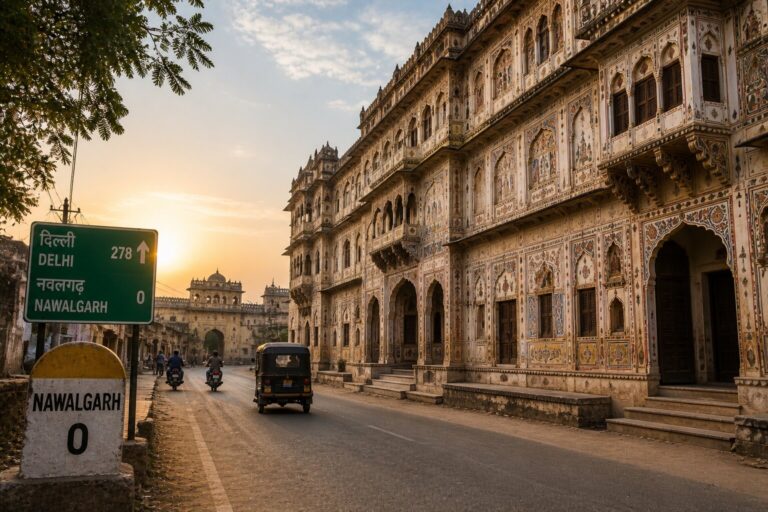
A typical haveli was built around two courtyards: the outer one (mardana) for business dealings and male visitors, the inner one (zenana) reserved for the family and women. A single large gateway controlled access. The structure closed itself off from the street entirely — a practical response to desert heat and the need for privacy — while opening upward to the sky through its inner courts. Carved wooden doors, jharokhas (overhanging balconied windows), and ornamented gateways announced the family’s status before you even stepped inside.
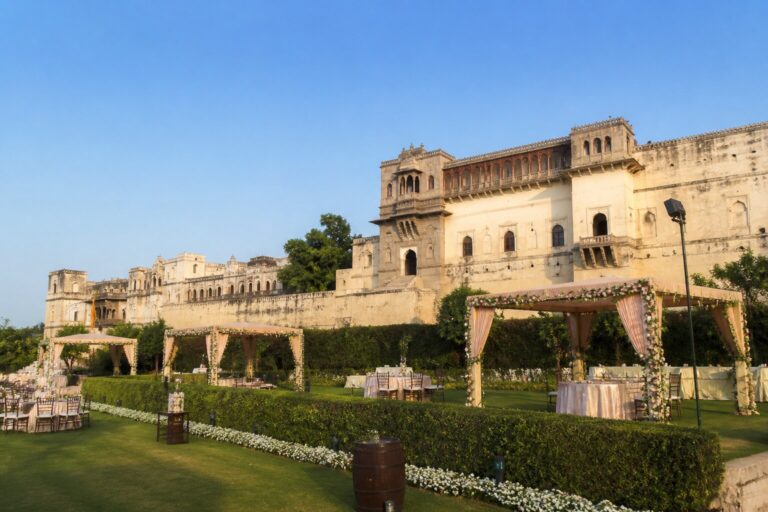
The havelis were not the only things being built. The region filled with forts, temples, chhatris (elevated dome-shaped pavilions built as memorial cenotaphs for the wealthy and distinguished), and stepwells. The chhatris of Shekhawati are particularly remarkable — their domed ceilings often feature a rasamandala, the dancing circle in which Krishna miraculously replicates himself for each of the Gopis. Stepwells, called baoris, were functional masterpieces: deep stone-lined wells with descending staircases that provided cool water year-round in a land with almost no rivers. Many were decorated with fresco paintings on their stone walls.
Each merchant family competed fiercely to build the grandest haveli. The competition drove both scale and decoration to remarkable heights. Some havelis have over a thousand windows. Some have entirely painted exterior facades visible from the street, making the town itself a gallery. A family that could afford Belgian mirror fragments in their interiors or Italian chandeliers overhead made sure their neighbours knew it.
The Art of the Frescoes: Technique, Colour, and Meaning
The frescoes of Shekhawati are not just decoration. They are a visual archive of three centuries of history, faith, commerce, and cross-cultural encounter. No other place in India documents its own past this way — not in a museum, but on the walls of lived-in buildings, in the open air, free for anyone to read.
The painting technique was highly specialised. The base plaster, called arayish, was a complex recipe: lime, marble powder, powdered seashell, buttermilk, sugar, and curd, layered in multiple coats and polished with agate stone to a semi-shiny finish. This is similar to the Italian fresco lustro technique, though the Shekhawati version evolved entirely independently in the desert. On this base, the painters — called chiteras, belonging to the Kumhar (potter) caste, also known as chejaras (mason-painters) — applied pigments on wet plaster so the colours bonded chemically as the surface dried. The result was extraordinary durability: paintings that have survived desert heat, monsoon humidity, and two centuries of neglect, and still carry their colours.
The pigments were entirely natural until the late 19th century. Kajal (lamp black) for black, safeda (lime) for white, neel (indigo) for blue, geru (red stone powder) for red, kesar (saffron) for orange, pevri (yellow clay) for yellow ochre — each mixed in limewater and beaten into the wet plaster. The symbolism was as deliberate as the technique: lotuses denoted purity, peacocks represented beauty and divine love, elephants signalled power and prosperity, and a flanking pair of painted elephants at a gateway marked the haveli as a place of significance and blessing.
The colour palette shifted by era, offering historians a reliable dating tool. Maroon dominated from roughly 1820 to 1865. Red and blue held sway between 1860 and 1910. By 1860, German chemical pigments — ultramarine, chrome red, emerald green — had reached India and opened new possibilities. Multi-coloured paintings using cheaper European paints dominated from 1900 to 1950. (One story holds that painters, inspired by “Made in Germany” paint tins, began randomly inscribing the word “Germany” on paintings to indicate anything modern or English.)
Two fresco techniques were used. The outer walls of havelis typically used buon fresco (fresco-buono): pigments applied to wet plaster, which then carbonates as it dries, locking the colour permanently into the surface. Interior ceilings and walls often used fresco-secco (painting on dry plaster with a binding medium), which was more flexible but less durable. This is why outer frescoes have generally survived better than interior ones.
The themes of the paintings tell the entire social history of the region in sequence. Early frescoes (17th to early 18th century) depict Hindu mythology: scenes from the Ramayana, Mahabharata, and Bhagavata Purana, portraits of Rajput rulers, hunting scenes, and local folk legends like Dhola-Maru (the Rajasthani romantic tale of two lovers on a camel) and the story of Laila-Majnu. By the mid-19th century, the world outside had begun to appear on the walls. Steam trains, British officers, bicycles, gramophones, portraits of Queen Victoria, and even Mary and Jesus on temple ceilings sit beside scenes of Krishna playing his flute. This blending was not confused or accidental. It was a deliberate expression of the Marwari merchant worldview: deeply Hindu in faith, globally curious in commerce, and entirely at ease with the collision of East and West.
The painters themselves were often self-taught, drawn from the mason and potter communities. For the finest work, teams of professional painters were brought in from Jaipur and its surrounding areas. Where artists have signed their work, the signatures are almost always from Jaipur or nearby — evidence of a mobile artistic community following the wealth wherever it gathered.
You can stand before a fresco in the Vivaana Culture Experience in Mandawa and read all of this. The art is not just beautiful. It is a document.
The Decline: Railways, Migration, and the Quieting of the Towns
No golden age lasts. Shekhawati’s began to end in the second half of the 19th century, and the cause was not war or drought but technology.
The British Raj built railways across India. New lines connected the interior directly to Bombay and Calcutta. The overland caravan routes that had made Shekhawati’s towns rich for over a century lost their commercial purpose. From the late 19th century, the Marwari merchant families shifted their commercial bases to Calcutta, Bombay, Surat, and later Delhi. They did not struggle there. They thrived. The Poddars, Goenkas, Bajaj, Modi, and Birla families became among the most powerful industrialists in Indian history. By some estimates, more than half the assets in the modern sector of the Indian economy came to be controlled by trading castes from the northern half of Rajasthan, the majority originating in just a dozen small towns of Shekhawati.
But their hometowns emptied. The grand havelis they left behind were locked, entrusted to caretakers, and visited only for weddings, festivals, and death rituals. Without full-time residents, the frescoes began to fade. Temperature fluctuations, humidity, pollution, biological growth, and structural neglect began to take their toll. Some havelis were demolished. Some were sold. Some simply leaned into the desert and waited.
The mid-20th century, particularly after Indian independence in 1947, saw the final dismantling of the thikana system. The Rajasthan Land Reforms and Resumption of Jagirs Act of 1952 ended the intermediary landholding structures that had governed the region for five centuries. The modern districts of Jhunjhunu and Sikar were carved out. Shekhawati became, administratively, an ordinary part of Rajasthan rather than a distinctive cultural territory.
Shekhawati’s Military Legacy and Its People
One aspect of Shekhawati’s history that deserves its own recognition is the region’s extraordinary contribution to the Indian military. The Shekhawat Rajputs were renowned warriors — Colonel J.C. Brooke wrote in his Political History of India that “for the recruitment of Horse-army there is no region in India at par with Shekhawati”. That tradition continued long after the Rajput era ended.
Shekhawati has produced an unusual concentration of decorated military figures. Piru Singh Shekhawat was awarded the Param Vir Chakra, India’s highest gallantry award, for extraordinary bravery. The region has sent soldiers to virtually every major Indian military campaign. In almost every village in Shekhawati, you will find a statue or memorial to a local war hero. This is a land that takes courage seriously — both the kind painted on haveli walls and the kind demonstrated on a battlefield.
Shekhawati Today: Heritage Revived and Rediscovered
The story does not end with abandonment. It takes a different turn — slowly, but unmistakably.
Over the past three decades, Shekhawati has been rediscovered. First by heritage photographers and travellers who spread word of the painted towns. Then by conservation organisations: the Shekhawati Project, an international team of expert conservators, architects, and historians, has been working since 2016 on restoring frescoes across the region, including work on the Gulab Rai Ladia Haveli in Mandawa. International bodies including UNESCO have noted Shekhawati’s cultural landscape as a heritage of global significance.
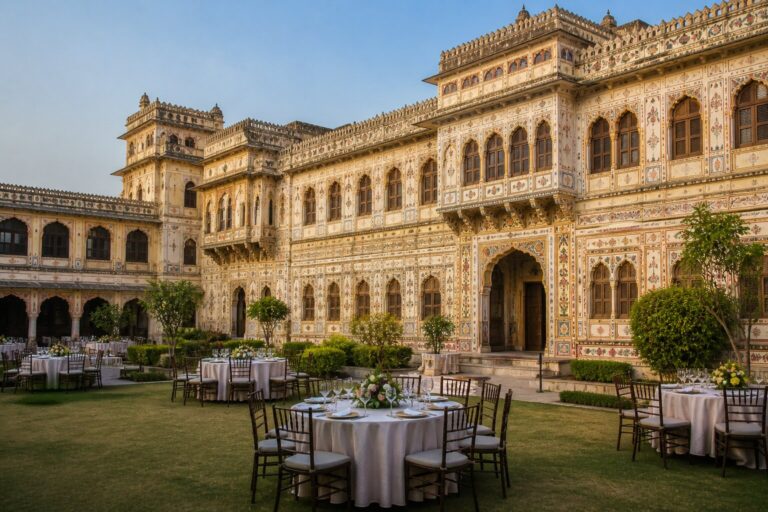
Heritage hotels have played a critical role. When a haveli is restored and opened as a hotel, its frescoes are maintained, its structure is stabilised, and local craftspeople find work preserving traditional skills. Guests who stay in these properties don’t look at history from outside a rope barrier — they sleep beneath painted ceilings, eat in frescoed courtyards, and wake each morning to walls that have stood for two hundred years.
Vivaana’s properties are part of this revival. The Vivaana Museum Hotel in Nawalgarh is a restored 19th-century haveli that now houses the Shekha Museum — a curated collection of historical artefacts from the merchant era. The Vivaana Culture Hotel in Mandawa is a 150-year-old twin haveli with original frescoes throughout. The Neem Haveli offers a quieter, more intimate experience of the same heritage. In each case, staying here is not choosing a hotel. It’s choosing a relationship with the history of the place.
The towns themselves — Mandawa, Nawalgarh, Jhunjhunu, Fatehpur, Ramgarh, Dundlod, Churu, Bissau, Alsisar — each carry different chapters of this history. Mandawa is the most visited, with the fort founded by Nawal Singh (son of Sardul Singh) in the 18th century, and havelis including the Chokhani double haveli and the Murmuria Haveli. Nawalgarh has the richest concentration of museums and the Podar Haveli Museum. Fatehpur holds the beautifully restored Nadine Le Prince Haveli, a 19th-century mansion taken over and restored by a French artist. Ramgarh, lesser known, has some of the most vivid and intact frescoes in the region, with paintings covering not just havelis but shops, temples, and wells.
Together, these towns form what has been called the world’s largest open-air art gallery — a title that refers not just to the quantity of art but to the fact that it has never been moved into a museum. It is still here, in the towns where it was made, available to anyone willing to walk a little slowly and look a little carefully.
The history of Shekhawati is a story about what happens when geography, ambition, faith, and art combine in the same place over the same centuries. It begins with a Rajput chieftain blessed with the name of a Sufi saint, passes through the extraordinary wealth of merchant families who painted their entire world onto plaster, and arrives in the present as a living gallery that is only now beginning to receive the attention it deserves.
Walking through Shekhawati is walking through all of this at once. The past does not sit behind glass here. It is on the walls, in the lanes, in the courtyards of old havelis that still creak and breathe in the desert wind. Some of those havelis have been restored. Some are still crumbling. All of them are still speaking, in colours that have endured for two centuries.
If you want to hear what they say, Vivaana Heritage Hotels offer a place to listen. Explore the Vivaana Museum Experience and the Culture Experience — each a window into what Shekhawati has always been.
Explore the Region
Plan Your Shekhawati Journey with Vivaana
From curated fresco walks to immersive museum experiences — Vivaana’s properties in Mandawa and Nawalgarh are the ideal base for discovering Shekhawati’s painted history.
Mandawa
Vivaana Culture Experience
Curated experiences rooted in Shekhawati culture — fresco walks, folk performances, and living history.
Nawalgarh
Vivaana Museum Experience
Step inside the Shekha Museum and explore artefacts, art, and stories from Shekhawati’s merchant era.
Frequently Asked Questions
What is the history of Shekhawati in brief?
Shekhawati is a region in northeastern Rajasthan whose history spans from the ancient Matsya Kingdom mentioned in the Mahabharata through Rajput rule, Mughal alliances, and a golden age of merchant wealth in the 18th and 19th centuries. The region takes its name from Maha Rao Shekha Ji, a Kachhwaha Rajput chieftain who declared independence in 1471. Wealthy Marwari merchant families later built hundreds of fresco-painted havelis here, making Shekhawati one of the world’s most remarkable concentrations of mural art. The arrival of British railways shifted trade routes in the late 19th century, leading to merchant migration and gradual decline, though heritage tourism and restoration efforts have renewed the region’s cultural life in recent decades.
Why is Shekhawati called the Open Art Gallery of India?
Shekhawati holds this title because its towns contain hundreds of havelis, temples, chhatris, and stepwells whose exterior and interior walls are covered with elaborate fresco paintings. These murals were commissioned by Marwari merchant families between the 17th and early 20th centuries and depict Hindu mythology, daily life, folk legends, trade imagery, and colonial-era subjects including steam trains and British officers. Unlike a conventional gallery, the art is not behind glass — it is painted on the buildings of living towns, visible to anyone who walks the streets.
Who were the Marwari merchants of Shekhawati and why did they build havelis?
The Marwari merchants were trading families of the Marwar region who settled in Shekhawati to benefit from its low-tax trade routes connecting inland India to the ports of Gujarat. Prominent families included the Poddars, Goenkas, Kotharis, Singhania, Bajaj, and Modi clans. They grew enormously wealthy and built grand havelis as symbols of their status, faith, and cultural identity. The havelis were designed to impress rivals, welcome business partners, and demonstrate prosperity — which is why each family tried to commission more elaborate frescoes than their neighbours.
What is the arayish fresco technique used in Shekhawati?
Arayish is the unique plaster base developed in Shekhawati for fresco painting. It is a mixture of lime, marble powder, powdered seashell, buttermilk, sugar, and curd, applied in multiple layers and polished with agate stone to a semi-shiny finish. Pigments were then applied to the wet surface, bonding chemically with the plaster as it dried. This technique, similar to the Italian fresco lustro method, produced extraordinary durability. Natural pigments including indigo, red ochre, saffron, and lamp black were used until the late 19th century, when German chemical paints began to arrive in India.
Which towns in Shekhawati are most worth visiting for heritage?
The main heritage towns in Shekhawati are Mandawa, Nawalgarh, Jhunjhunu, Fatehpur, Ramgarh, Dundlod, and Churu. Mandawa is the most visited, with a fort founded in the 18th century and rich haveli collections including the Chokhani and Murmuria havelis. Nawalgarh has the highest concentration of restored museums and heritage hotels. Fatehpur holds the beautifully restored Nadine Le Prince Haveli. Ramgarh is considered by many connoisseurs to have the most intact and vivid frescoes in the region. Vivaana Heritage Hotels operates restored properties in both Mandawa and Nawalgarh, offering guided heritage experiences across all these sites.