
TL;DR: Nawalgarh holds nearly 200 fresco-painted havelis, more than almost any other town in Rajasthan’s Shekhawati region. The paintings were created using a local technique called arayish, where natural pigments were applied onto wet lime plaster mixed with marble dust, seashell powder, and curd. Subjects range from Hindu mythology to steam trains and British officers. The Podar Haveli Museum alone has over 750 frescoes. Walking through Nawalgarh is as close as you’ll get to an open-air art gallery in India.
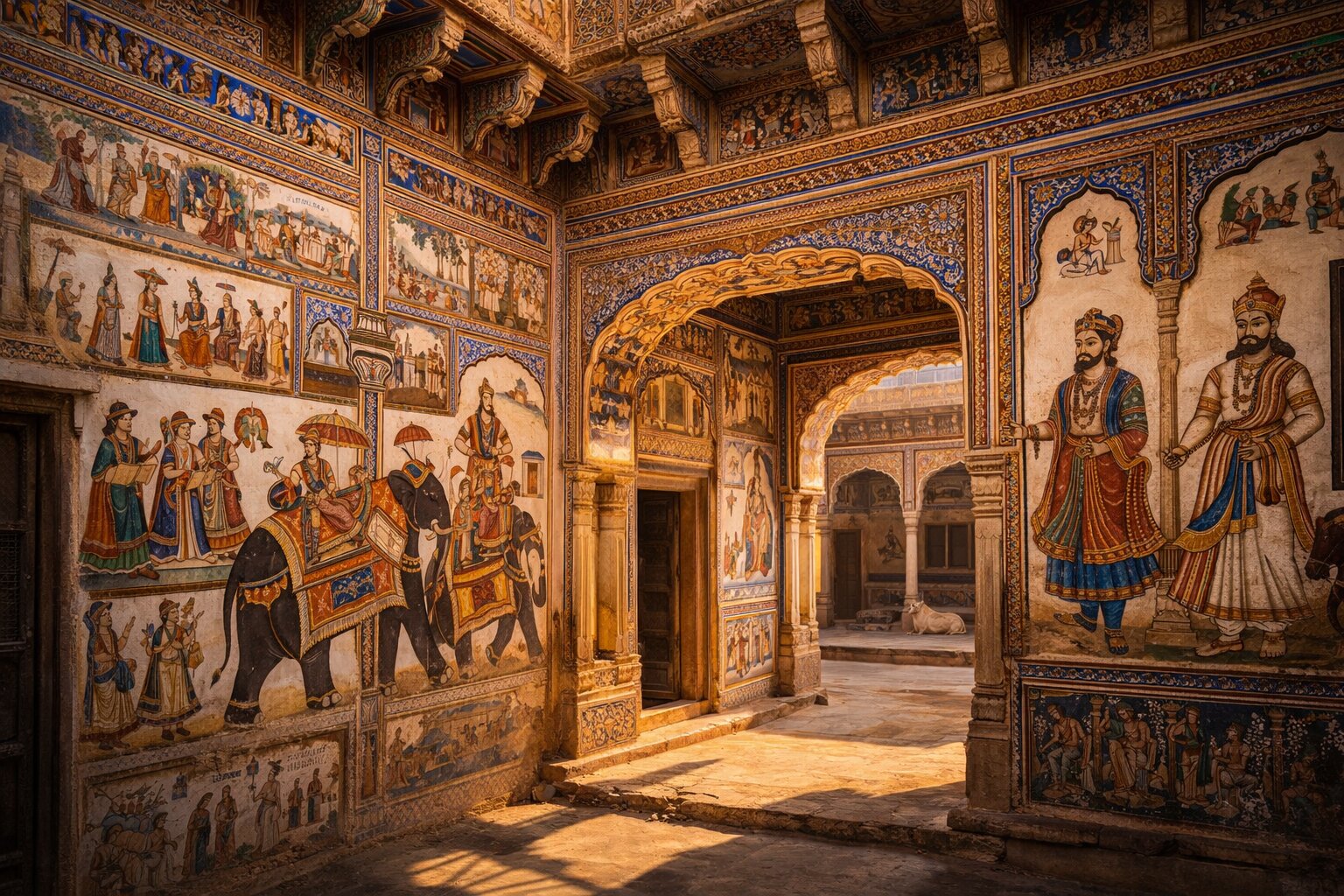
There’s a haveli in Nawalgarh where Krishna plays the flute on one wall and a steam engine pulls into a station on the next. A few metres away, a British couple in formal dress stares out from a panel beside a Rajput king on horseback. None of it should work together. All of it does.
This is what makes Nawalgarh’s frescoes so unusual. They aren’t curated or consistent. They’re the visual diaries of merchant families who saw the world through trade and brought it home to their walls. The result is one of India’s most concentrated and eclectic collections of painted havelis, scattered across a town you can walk end to end in under an hour.
What Is the Arayish Fresco Technique?
Arayish (also called alla-gila or morakashi in different parts of Rajasthan) is the painting method behind virtually every fresco in Shekhawati. It works like Italian fresco lustro: artists paint directly onto wet plaster, and as the surface dries, the pigments bond chemically with the lime. The colour doesn’t sit on the wall. It becomes part of it.
The plaster itself is a mixture of lime, marble powder, powdered seashell, curd, and natural pigments. Once applied, the surface was polished with an agate stone, which gave it a smooth, slightly glossy finish. The whole process had to be done quickly, because once the plaster dried, the window closed.
Pigments came from local materials. Red from vermillion, blue from indigo, white from lime, black from kohl. After the mid-19th century, cheaper synthetic pigments from Germany (particularly ultramarine blue and chrome red) began replacing the natural ones. You can often tell the age of a fresco by its colour palette: the older ones are earthier, the later ones brighter and sometimes a bit garish.
Only a handful of craftsmen still practise this technique today. The Shekhawati painting tradition is at real risk of disappearing unless active efforts are made to train new artisans.
What Stories Do the Frescoes Tell?
The subjects painted across Nawalgarh’s walls fall into broad categories, but the interesting part is how freely they mix. A single wall can jump from the Ramayana to a railway scene to a portrait of Queen Victoria without any apparent logic. That’s because these weren’t planned galleries. They were personal expressions of what mattered to the family who commissioned them.
Mythology and religion: Scenes from the Mahabharata and Ramayana appear everywhere. Krishna is by far the most popular figure, followed by Rama, Ganesh, and Durga. You’ll find Ganesh painted above nearly every doorway.
Daily life: Markets, weddings, processions, and village activities. These give an unfiltered look at how people actually lived in 18th and 19th-century Shekhawati.
Trade and travel: Ships, camel caravans, and early automobiles. The merchants who commissioned these frescoes had seen the world, and they wanted their walls to show it.
Colonial influences: Steam trains, British officers, European women in Victorian dress, gramophones, and even bicycles. Some havelis feature portraits of Jesus Christ alongside Hindu deities, which gives you a sense of how freely artists borrowed from every visual reference available.
Decorative patterns: Floral borders, geometric motifs, and symmetrical designs fill the spaces between narrative scenes. These served as frames, connecting the larger paintings into a unified visual flow across walls, ceilings, and pillars.
The Ceilings and Pillars That Most Visitors Miss
Wall frescoes tend to get most of the attention, which is understandable. They’re at eye level. But some of the finest work in Nawalgarh is above your head.
Haveli ceilings were painted with radiating patterns, often spiralling outward from a central medallion. The designs are more geometric and symmetrical than the walls, which tend to be narrative and figurative. Pillars framing the courtyards carry their own painted panels, usually smaller scenes or decorative motifs that tie the room together visually.
The effect is best appreciated in the early morning or late afternoon, when natural light comes in at an angle and catches the polished arayish surface. The glossy finish, which agate polishing creates, gives the frescoes a subtle sheen that flat photographs never quite capture. If you visit, take a few minutes to just sit in a courtyard and look up. It’s worth the neck strain.
Which Havelis Have the Best Fresco Art?
Nawalgarh has nearly 200 painted havelis, but only three are regularly open to visitors. Each offers something different.
Podar Haveli Museum: The most visited, and for good reason. Built in 1902, it holds over 750 frescoes covering more than 11,200 square metres. The paintings span Hindu mythology, royal life, and modern inventions. Converted into a museum in 1995 with 19 thematic galleries, it also displays Rajasthani turbans, jewellery, musical instruments, and bridal costumes. Plan at least 90 minutes here.
Morarka Haveli: A short walk from the Podar Museum. Built around 1900, this one feels more raw and authentic. The frescoes haven’t been heavily restored, so you see both the original artistry and the effects of time. The colour palette leans toward indigo blue and red. One unusual detail: it contains two portraits of Jesus Christ, a rarity in Shekhawati havelis.
Aath Haveli Complex: A cluster of eight interconnected havelis in a quieter part of town. Less crowded, less curated, and worth the detour if you want to see frescoes in a more intimate setting rather than a museum context.
Beyond these three, dozens of unrestored havelis line the old bazaar streets. Their frescoes are faded and some walls are crumbling, but they offer a different kind of experience: fresco art as it was actually lived with, not preserved behind a museum ticket.
Stay in Shekhawati
Sleep Inside the Frescoes
Two restored 19th-century havelis. One unforgettable journey through Shekhawati.
Nawalgarh
Vivaana Museum Hotel
Jaipuria Haveli, Nawalgarh
A beautifully restored haveli in the heart of town. Home to the Shekha Museum, rooftop pool, and authentic Rajasthani dining.
Mandawa
Vivaana Culture Hotel
Churi Ajitgarh, Mandawa
A 150-year-old twin haveli with original frescoes, curated cultural experiences, and the warmth of Shekhawati hospitality.
Why Did Merchants Spend So Much on Wall Art?
This is the question that gets interesting once you stop thinking of havelis as houses and start thinking of them as billboards.
The Marwari merchants who built Nawalgarh’s grandest havelis were traders, not aristocrats. They didn’t have royal titles or ancestral forts. What they had was money, and they used architecture and art to show it. A haveli with 750 frescoes told every visitor (and every neighbour) exactly how successful the family was.
Competition drove the whole thing forward. When one family commissioned an elaborate entrance with elephant murals and mythological scenes, the family across the street would commission something bigger. The artists benefited from this rivalry. They were given time, materials, and creative freedom. Many worked in family crews, with skills passed from father to son within the potter and mason castes (the Kumhars and Chejaras).
The result was an arms race of beauty. And because the merchants travelled to Kolkata, Mumbai, and even overseas, they brought back visual references that local artists had never seen. That’s how you end up with a steam engine painted next to Krishna’s flute. The patron described what he’d seen; the artist interpreted it on plaster.
What Is Being Done to Save These Frescoes?
When merchant families left Nawalgarh for larger cities in the early 20th century, most havelis were locked up or left with a single caretaker. Decades of desert sun, monsoon rain, and simple neglect took their toll. Many frescoes faded. Some walls collapsed entirely.
But the arayish technique was built to last. Because the pigments bond with the lime plaster during drying, the colours resist weathering better than paint applied to a dry surface. Even in havelis that haven’t been touched in a century, you can still make out vivid blues and reds on protected interior walls.
Conservation efforts now come from several directions. Vivaana Heritage Hotels has restored two Shekhawati havelis into heritage stays, one in Nawalgarh and one in Mandawa, keeping original frescoes intact. The Shekhawati Project, an international team of conservators based in Paris, has been running workshops in the region since 2016, training local artisans in traditional restoration methods. And the Podar family’s museum conversion remains the most visible success story.
The bigger challenge is scale. Shekhawati has over 2,000 painted havelis across its towns. The ones in Nawalgarh and Mandawa get attention because they’re on the tourist trail. Many others, in smaller towns like Ramgarh, Fatehpur, and Mahansar, sit in advanced decay with no restoration plan.
How to Experience Nawalgarh’s Frescoes
A few practical notes for getting the most out of a visit.
Start at the Podar Haveli Museum. It’s the best-maintained site and gives you a visual vocabulary for spotting fresco styles and themes across the rest of the town. Morarka Haveli is a five-minute walk away and offers a rawer, less polished counterpoint.
After the museums, wander the old bazaar area on foot. The unrestored havelis here are the real surprise. Some have shopfronts built into their facades, with painted elephants and mythological scenes looking down over stacks of saris or grain sacks. Nobody charges admission. You just look up.
Go early in the morning or late in the afternoon. The angle of light matters with arayish surfaces, and midday sun washes out the colours. A local guide helps, not just for navigation but for reading the stories. Many frescoes reference specific episodes from the Mahabharata or local folklore that aren’t obvious without context.
If you want the most immersive experience, stay inside a restored haveli. Sleeping in a room where the walls were painted 150 years ago, eating breakfast in a courtyard surrounded by faded murals, stepping out the front door into streets lined with painted facades. That’s something you can’t replicate in a day trip from Jaipur.
The Vivaana Museum Hotel in Nawalgarh is built around this idea: the hotel itself is part of the heritage, not just a place to sleep near it.
What Makes Nawalgarh’s Frescoes Different From Other Rajasthani Art?
Rajasthan has no shortage of wall paintings. The Jaipur City Palace, Bundi’s Garh Palace, and the Mehrangarh Fort in Jodhpur all have painted interiors. But Nawalgarh’s frescoes are different in three ways that matter.
First, they’re domestic. These weren’t palace commissions or temple decorations. They’re the art of private homes, which means they reflect personal taste rather than royal agenda. The subjects are more varied and more eccentric because of it.
Second, they’re dense. Nearly 200 painted havelis in a single town, many within walking distance of each other. You can see a dozen different artistic styles and periods in a morning. Nowhere else in Rajasthan offers that kind of concentration.
Third, they’re accessible. You don’t need a palace ticket or a museum appointment. Many of the best frescoes are on exterior walls, visible from the street. The whole town functions as an open-air gallery, which is why the phrase gets used so often. In Nawalgarh’s case, it’s not an exaggeration.
The Art That Stayed Behind
When the merchant families left Nawalgarh, they took their furniture, their jewellery, and their business ledgers. They couldn’t take the walls.
That’s the strange gift of fresco art. Because the paint is fused into the plaster, it doesn’t travel. It stays exactly where the artist put it, whether anyone is there to look at it or not. For decades, some of the finest domestic art in India sat behind locked doors in a small desert town, seen by nobody.
Now people are looking again. Slowly. The town isn’t overrun with tourists, and that’s part of what makes it worth visiting. You can stand in front of a 200-year-old fresco of Krishna’s leela, and there’s nobody between you and the wall. No rope. No glass. Just the paint, the plaster, and whatever the artist wanted to say.
For anyone drawn to Rajasthan’s cultural heritage, Nawalgarh’s frescoes are not a side trip. They’re the main event.
Stay in Shekhawati
Sleep Inside the Frescoes
Two restored 19th-century havelis. One unforgettable journey through Shekhawati.
Nawalgarh
Vivaana Museum Hotel
Jaipuria Haveli, Nawalgarh
A beautifully restored haveli in the heart of town. Home to the Shekha Museum, rooftop pool, and authentic Rajasthani dining.
Mandawa
Vivaana Culture Hotel
Churi Ajitgarh, Mandawa
A 150-year-old twin haveli with original frescoes, curated cultural experiences, and the warmth of Shekhawati hospitality.
Frequently Asked Questions
What is the arayish fresco technique used in Nawalgarh?
Arayish is a wet-plaster painting technique unique to Rajasthan’s Shekhawati region. Artists apply natural pigments onto a freshly prepared surface made from lime, marble powder, powdered seashell, and curd. As the plaster dries, the colour bonds with the lime and becomes part of the wall. The surface is then polished with agate stone for a smooth, semi-glossy finish. The technique is similar to the Italian fresco lustro method.
How many frescoes are in Nawalgarh’s Podar Haveli?
The Podar Haveli Museum contains over 750 frescoes spread across its outer walls, passageways, two courtyards, and lower-level rooms. The frescoes cover more than 11,200 square metres and depict subjects ranging from Hindu mythology and royal processions to steam trains and European figures. The museum also has 19 galleries displaying Rajasthani cultural artefacts.
What subjects are painted on Nawalgarh’s haveli walls?
The frescoes cover a wide range of themes. Hindu mythology (especially Krishna and Rama) is the most common, followed by scenes of daily life, royal processions, trade and travel imagery, and colonial-era subjects like British officers, steam trains, gramophones, and Victorian women. Some havelis also feature religious imagery from outside Hinduism, including rare portraits of Jesus Christ.
When is the best time to see the frescoes in Nawalgarh?
October to March offers the most comfortable weather for walking the town. For viewing the frescoes themselves, early morning and late afternoon light brings out the best detail and colour, especially on the polished arayish surfaces. Midday sun tends to wash out the paintings. The annual Shekhawati festival in February is a good time to visit if you want guided tours and cultural events alongside the heritage walks.
Can you stay inside a painted haveli in Nawalgarh?
Yes. Vivaana Museum Hotel in Nawalgarh is a restored 19th-century Jaipuria Haveli with original frescoes in many of its rooms and corridors. It includes an on-site museum, rooftop pool, and traditional Rajasthani dining. In nearby Mandawa, Vivaana Culture Hotel offers a similar heritage experience inside a 150-year-old twin haveli.