
TL;DR: Nawalgarh has three museum-havelis open to visitors: Podar Haveli Museum (750+ frescoes, 19 galleries), Morarka Haveli Museum (700+ original artworks, conservation-focused), and the Aath Haveli Complex (a quieter cluster of eight connected mansions). All three are in the Naya Bazaar area, within walking distance of each other. Start with Podar for context, visit Morarka for authenticity, then wander the painted streets. Budget 2-3 hours for the full circuit.
The word “museum” sets the wrong expectations for Nawalgarh. If you’re picturing white walls, glass cases, and laminated information panels, you’ll be confused when you arrive. The museums here are havelis. They’re the original mansions, with the original frescoes still on the walls, the original courtyards still open to the sky, and in some rooms, the original wooden doors still hanging on their hinges.
What makes these spaces worth visiting isn’t just the art (though there’s a lot of it). It’s the fact that you’re standing inside the buildings where Marwari merchant families actually lived, conducted business, and raised children. The art is inseparable from the architecture. The museum is the building. The building is the exhibit.
Here’s what each one offers, how they’re different, and how to see them in the right order.
What Is the Podar Haveli Museum?
The Podar Haveli Museum is the most visited site in Nawalgarh, and the logical place to start any visit. It was built in 1902 by Seth Anandilal Podar, a Marwari businessman based in Mumbai with interests in cotton mills. In 1955, the haveli was converted into a school. In 1995, Anandilal’s grandson Kantilal Podar transformed it into a museum.
The numbers tell part of the story: over 750 frescoes covering more than 11,200 square metres of wall, ceiling, and corridor space. The subjects range from Hindu deities and episodes from the Mahabharata and Ramayana to images of steam trains, early automobiles, and British couples in formal dress. One fresco above the main entrance depicts the first train journey in India (Bombay to Thane, 1853), painted by an artist who had almost certainly never seen a train.
Beyond the frescoes, the museum has 19 thematic galleries. These cover Rajasthani culture in broad strokes: bridal costumes, traditional jewellery, turban styles, musical instruments, miniature paintings, and carved wooden doors. The galleries are well-labelled and give useful context, especially if you’re new to Shekhawati’s history.
Podar is the most restored, most polished, and most structured of Nawalgarh’s museums. That’s both its strength and its limitation. The frescoes have been cleaned and repainted in places, which makes them vivid but less raw than what you’ll find at Morarka. The experience is guided, curated, and comfortable. Plan at least 90 minutes.
Entry: 100 INR per person (camera fee 30 INR extra). Located on Rambilas Podar Road in the Naya Bazaar area.
How Is the Morarka Haveli Different From Podar?
The Morarka Haveli sits a five-minute walk from Podar, but it feels like a different era. Built around 1900 by Jairam Dasji Morarka, this haveli was converted into a museum in 1995 by his descendant, Kamal M. Morarka. The philosophy here is conservation, not restoration. The frescoes have been cleaned but not repainted. What you see is what the artists originally put on the walls.
That distinction matters more than it might sound. At Podar, the colours are bright and the lines are sharp because restorers have gone over them. At Morarka, the colours are muted where time has faded them, and untouched where they’ve survived. Conservator Dr. Hotchand has been working for years to preserve close to 700 original artworks using traditional methods: limestone, red mud, and river sand to strengthen surfaces instead of cement; marble dust and slaked lime instead of synthetic resins. Over 160 sculpted doors and windows have also been restored.
The frescoes here lean toward mythology and daily life. Rich indigo blues and reds dominate the palette. The inner courtyard has detailed Ramayana scenes, and on the top storey, tucked beneath the eaves in the southeast corner, there’s an image of Jesus. It’s one of only a handful of Christian figures in Shekhawati’s havelis, painted without any apparent religious agenda. The artists simply painted what they saw and heard about.
Morarka is quieter than Podar. Fewer tour groups, fewer visitors in general. If Podar is the textbook, Morarka is the primary source.
Entry: 50 INR per person. The haveli also runs a Heritage Conservation Institute and has published books and coffee-table volumes on Shekhawati’s fresco tradition.
What Is the Aath Haveli Complex?
“Aath” means eight in Hindi. The Aath Haveli Complex is a group of eight interconnected havelis on the western side of Bala Qila Fort, built around 1900. They’re less formally organised as a museum, but that’s part of the appeal.
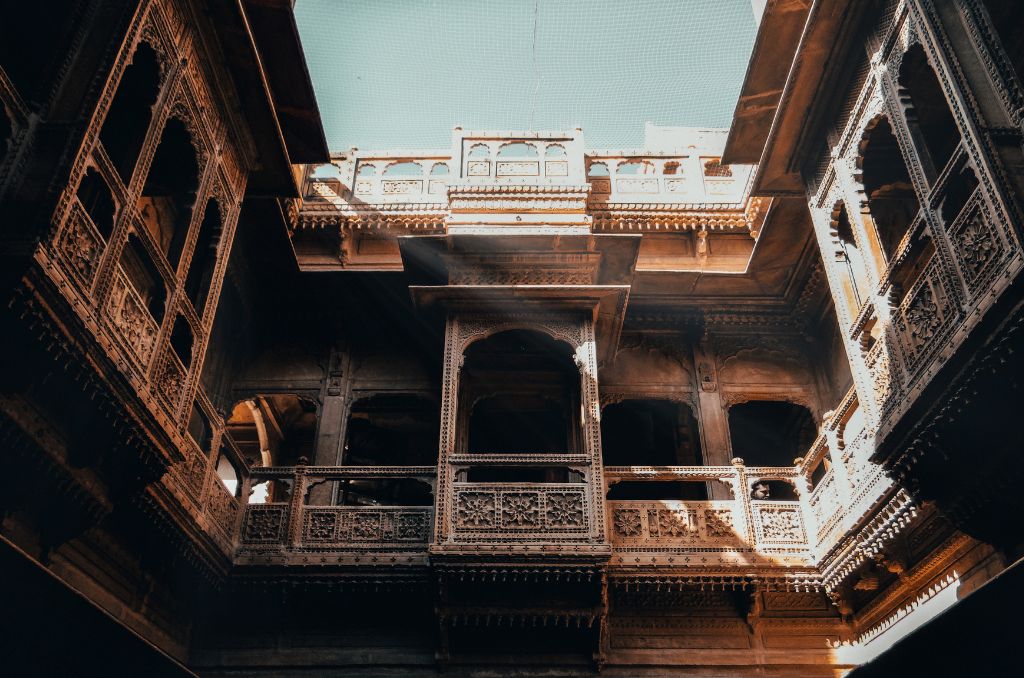
The frescoes here are in mixed condition. Some are well-preserved, others faded or damaged. The buildings themselves are grand, with the typical Shekhawati layout of dual courtyards (outer for business, inner for family), carved lintels, and painted pillars. But they lack the curation and labelling of Podar or the conservation expertise applied at Morarka.
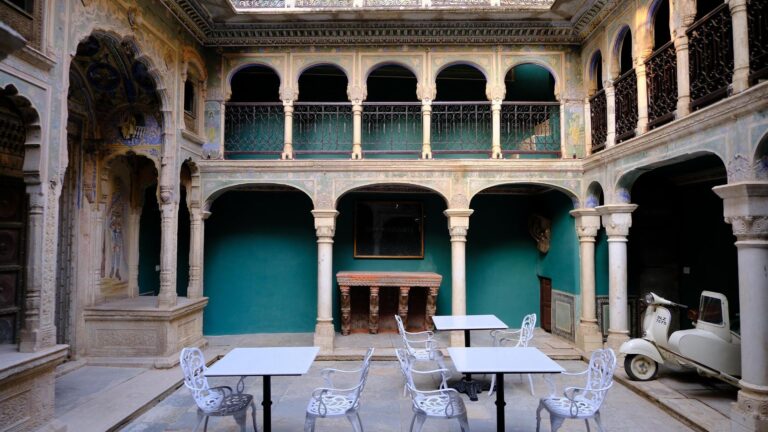
What the Aath Havelis offer instead is atmosphere. There are no guided tours. No ticket windows. You wander through rooms that haven’t been converted into galleries, where the relationship between the art and the living space is still visible. The nohara (animal enclosure area) still has its frescoes. The kitchens still have their shelving niches. The scale of the complex, eight mansions connected through passages and shared walls, gives you a feel for how an entire merchant quarter once functioned.
This is the right stop for anyone who’s already seen Podar and Morarka and wants something less polished and more atmospheric.
What About the Naya Bazaar Street Havelis?
The three museums sit within Nawalgarh’s Naya Bazaar area, and the streets connecting them are lined with dozens of unrestored havelis. This is where the “open-air art gallery” description actually earns its keep.
These aren’t museums. Many are private homes. Some are abandoned. A few have shopfronts built into their ground floors, with painted elephants and mythological scenes looking down over merchants selling grain or cloth. Nobody charges admission. You walk through, look up, and there’s a 150-year-old fresco of Krishna’s leela above a doorway that someone walks through every day without thinking about it.
The condition varies. Some frescoes are remarkably vivid, protected by overhanging eaves or the depth of a recessed doorway. Others are faded, cracked, or partially covered by modern signage. That contrast is part of the experience. You’re seeing heritage in its natural state: some preserved, some neglected, all of it real.
If you have extra time after the museums, walking the Naya Bazaar streets is the best way to spend it.
Stay in Shekhawati
The Museum Doesn’t End at Checkout
Two restored 19th-century havelis. One unforgettable journey through Shekhawati.
Nawalgarh
Vivaana Museum Hotel
Jaipuria Haveli, Nawalgarh
A beautifully restored haveli in the heart of town. Home to the Shekha Museum, rooftop pool, and authentic Rajasthani dining.
Mandawa
Vivaana Culture Hotel
Churi Ajitgarh, Mandawa
A 150-year-old twin haveli with original frescoes, curated cultural experiences, and the warmth of Shekhawati hospitality.
How Should You Plan a Museum Visit in Nawalgarh?
All three museums are in the Naya Bazaar area, within a 10-minute walk of each other. A half-day covers them comfortably. Here’s the sequence that works best.
First: Podar Haveli Museum (90 minutes). Start here because it gives you the vocabulary. The themed galleries explain fresco styles, materials, and cultural context. After Podar, you’ll recognise what you’re seeing at the other sites.
Second: Morarka Haveli (45-60 minutes). Walk from Podar. Now you can compare: restored frescoes versus conserved originals. Notice the difference in colour intensity and surface texture. The Morarka experience is quieter and more contemplative.
Third: Aath Haveli Complex and street havelis (30-60 minutes). Finish by wandering. No tickets, no guides. Just painted walls, courtyards, and the occasional surprise, like a 19th-century fresco of a ship above a tailor’s shop.
A few practical notes. Morning is better than afternoon. The light between 8 and 11 AM hits the arayish (polished lime plaster) surfaces at an angle that brings out the fresco colours. Most museums open by 9 AM. Carry cash: neither Podar nor Morarka accept cards. Hire a local guide if you can. The frescoes reference specific episodes from Hindu mythology and local history that aren’t self-explanatory to most visitors.
What Makes Nawalgarh’s Museums Different From Conventional Ones?
The short answer: in a normal museum, the building houses the collection. In Nawalgarh, the building is the collection.
The frescoes aren’t hung on walls. They are the walls. The courtyards aren’t re-created period rooms. They’re actual courtyards where merchant families held meetings, stored goods, and celebrated festivals. The carved wooden doors aren’t behind glass. You walk through them.
This creates an experience that conventional museums can’t replicate. At Podar, when you stand in the mardana (men’s quarter), you’re in the space where business was conducted. When you move to the zenana (women’s quarter), you see the domestic world: kitchens, water storage rooms, and the private courtyard where family life happened away from public view. The art on the walls reflects the function of each space. Religious scenes near the entrance. Decorative patterns in the living quarters. Status symbols (elephants, processions, traders with ships) on the exterior.
This isn’t accidental. The Marwari merchants who built these havelis designed every surface with intent. The museum conversion simply made that intent accessible to visitors.
Where to Stay for the Best Museum Experience
Day-tripping to Nawalgarh from Jaipur is possible (about 3.5 hours each way), but it limits you to one museum and a rushed walk through town. Staying overnight changes the dynamic entirely.
Vivaana Museum Hotel is in the Jaipuria Haveli, a restored 19th-century mansion in the heart of Nawalgarh with its own collection of historical artefacts and paintings. Sleeping inside a fresco-lined haveli after spending the day visiting fresco-lined museums is a continuity that deepens the whole experience. You stop seeing the art as something to visit and start understanding it as something people lived with.
In nearby Mandawa (30 minutes away), Vivaana Culture Hotel offers a similar heritage stay inside Churi Ajitgarh, a 150-year-old twin haveli. Combining a night in each town gives you coverage of Shekhawati’s two most important fresco centres.
More Than Painted Walls
It’s easy to reduce Nawalgarh’s museums to their frescoes, and the frescoes are the reason most people come. But what stays with you afterward isn’t any single painting. It’s the cumulative effect of walking through spaces where every surface was a canvas and every room told a story about how its owners saw the world.
A merchant who’d never left Rajasthan could look at his own walls and see a steam engine, a British officer, and Lord Krishna, all in the same line of sight. A family that worshipped at the temple next door could come home to ceilings covered in mythological scenes painted in the same colours they’d seen at the shrine.
That layering of the everyday and the extraordinary is what makes Nawalgarh’s museums unlike anything else in Rajasthan. The art is wonderful. The context is what makes it matter.
Stay in Shekhawati
The Museum Doesn’t End at Checkout
Two restored 19th-century havelis. One unforgettable journey through Shekhawati.
Nawalgarh
Vivaana Museum Hotel
Jaipuria Haveli, Nawalgarh
A beautifully restored haveli in the heart of town. Home to the Shekha Museum, rooftop pool, and authentic Rajasthani dining.
Mandawa
Vivaana Culture Hotel
Churi Ajitgarh, Mandawa
A 150-year-old twin haveli with original frescoes, curated cultural experiences, and the warmth of Shekhawati hospitality.
Frequently Asked Questions
How many museums are there in Nawalgarh?
There are three main museum spaces open to visitors: the Podar Haveli Museum (the largest, with 750+ frescoes and 19 galleries), the Morarka Haveli Museum (conservation-focused, with 700+ original artworks), and the Aath Haveli Complex (a cluster of eight connected havelis). All three are in the Naya Bazaar area, within walking distance of each other.
What is the difference between Podar Haveli and Morarka Haveli?
Podar has been extensively restored, with repainted frescoes and well-labelled thematic galleries. It’s the more polished, structured experience. Morarka takes a conservation approach: frescoes have been cleaned but not repainted, preserving the original artistry and the effects of time. Podar is better for first-time visitors. Morarka appeals to those who prefer authenticity over presentation.
How much time do you need for Nawalgarh’s museums?
Plan 2-3 hours for the full circuit: 90 minutes at Podar, 45-60 minutes at Morarka, and 30-60 minutes wandering the Aath Haveli Complex and the surrounding streets. If you’re a serious art or history enthusiast, you could easily spend a full half-day.
What are the entry fees and opening hours?
Podar Haveli Museum charges 100 INR per person (camera fee 30 INR extra). Morarka Haveli charges 50 INR per person. Both are generally open from 9 AM to 5 PM. The Aath Haveli Complex has no formal entry fee. Carry cash, as card payments aren’t accepted.
Where should you stay to visit Nawalgarh’s museums?
Vivaana Museum Hotel in Nawalgarh is a restored 19th-century haveli with original frescoes, an on-site museum, rooftop pool, and traditional Rajasthani dining. Staying inside a heritage haveli extends the museum experience into your accommodation. In nearby Mandawa, Vivaana Culture Hotel offers a similar heritage stay.