
TL;DR: Nawalgarh was founded in 1737 as a small fortified town in Rajasthan’s Shekhawati region. It grew into one of India’s wealthiest trading centres thanks to Marwari merchants who built grand havelis covered in vivid frescoes. Today, with nearly 200 painted mansions, Nawalgarh is called Shekhawati’s artistic capital and remains a living museum where centuries of art, trade, and culture still line the streets.
Walk through Nawalgarh’s old quarter early in the morning, and you’ll notice something unusual. The walls around you are covered in paintings. Gods and goddesses share space with steam engines. Portraits of merchants sit next to images of British men in top hats. Camels appear alongside ships that none of the local artists had ever seen in person.
This quiet town in Rajasthan’s Jhunjhunu district holds one of India’s richest collections of painted havelis. Yet most travellers pass through it on the way to somewhere else. That’s a mistake. The history of Nawalgarh is the story of how trade, wealth, and artistic ambition came together to turn a small desert settlement into an open-air art gallery.
How Did Nawalgarh Begin?
Before the 18th century, Nawalgarh didn’t exist. The area was a small village called Rohili. In 1737, Thakur Nawal Singh Ji Bahadur of the Shekhawat clan established a fortified town here and gave it his name. He received the land as a grant from his father, Maharao Shardul Singh, the ruler of Jhunjhunu.
Nawal Singh didn’t just build a settlement. He planned one. The town was surrounded by high walls with four main gates (pols) named Bawadi, Mandi, Agoona, and Nansa. A central fort called Bala Kila anchored the layout. Streets were organised into planned lanes and market areas. A second fort, Fatehgarh, stood outside the walls as an outpost.
This level of planning was unusual for the time. It made Nawalgarh one of the most modern towns in Shekhawati and set the stage for what came next.
What Made the Marwari Merchants So Important to Nawalgarh?
The Marwari merchants were the engine behind Nawalgarh’s transformation from a planned military town into one of India’s wealthiest settlements. Thakur Nawal Singh actively encouraged traders from Jaipur and other regions to settle here, and the strategy worked.
Shekhawati sat along ancient caravan routes that connected inland India to the western ports in Gujarat. Salt, opium, spices, and cotton moved through its market towns. Unlike neighbouring states that charged heavy taxes, Shekhawati’s rulers kept duties light. That made the region attractive to traders looking for a base to expand their businesses.
The Patodia and Murarka families were among the first to arrive on Nawal Singh’s invitation. Seeing them grow, other merchant families followed. By the mid-1800s, Nawalgarh had become a prosperous commercial centre. Many of modern India’s most prominent business families, including the Birlas, Goenkas, and Poddars, trace their roots to this town.
The wealth these families created didn’t just stay in bank accounts. It went onto walls.
The Painted Havelis: How Commerce Became Art
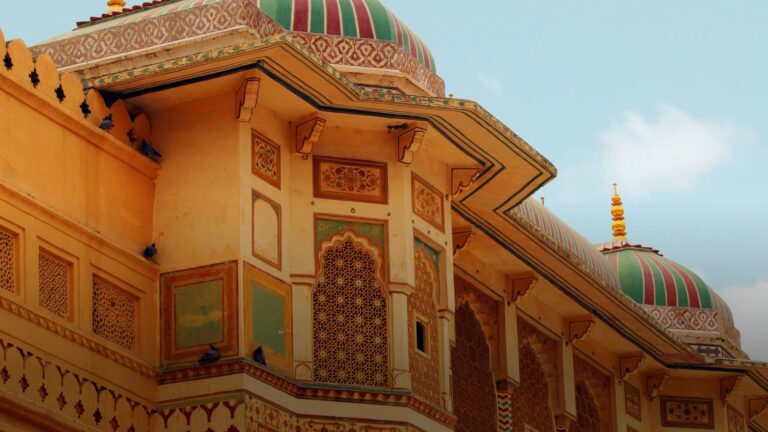
As Marwari merchants grew richer, they began building grand mansions called havelis. These weren’t just homes. They were symbols of status, expressions of taste, and, sometimes, friendly competitions between neighbours.
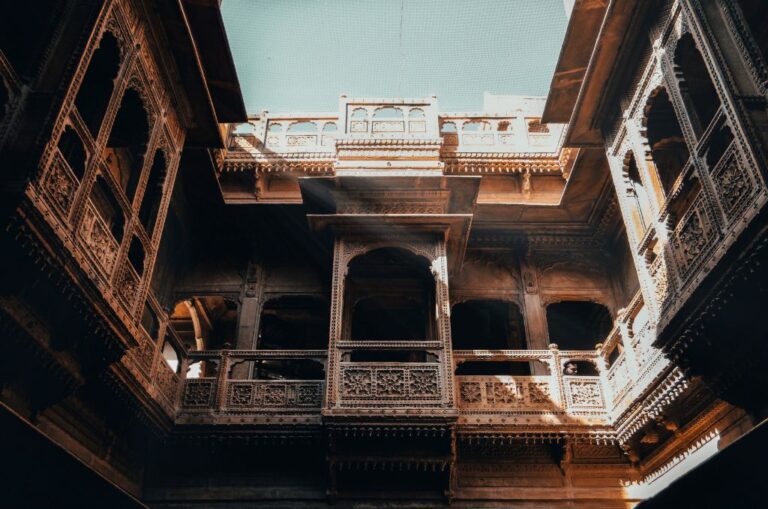
Each haveli followed a typical design: two courtyards (the outer one for business, the inner one for family), carved wooden doorways, arched corridors, and rooms arranged around the open centre for natural ventilation in the desert heat.
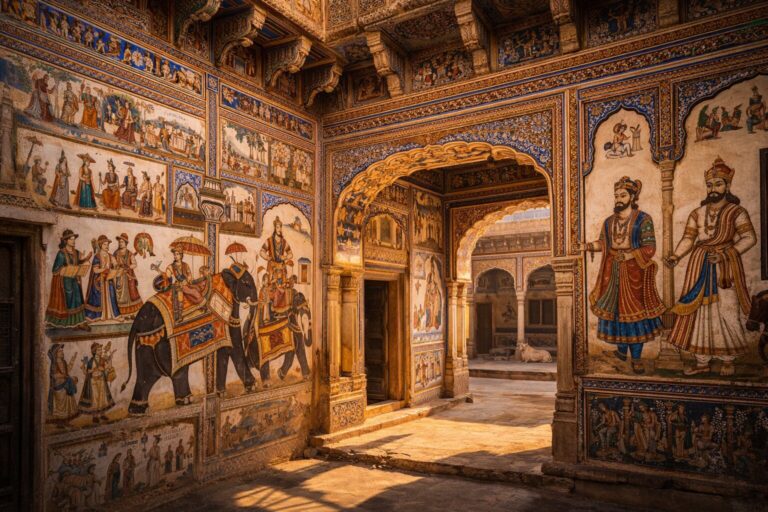
But what made Nawalgarh’s havelis special was their frescoes. Artists used a traditional technique called arayish, similar to Italian fresco lustro. Colours were painted onto wet plaster made from lime, marble powder, powdered seashell, and curd. Natural pigments came from local materials: red from vermillion, blue from indigo, white from lime, and black from kohl. Once dry, the surface was polished with agate stone to give it a smooth, semi-shiny finish.
The subjects were eclectic. Hindu mythology sat alongside scenes of daily life. Portraits of local rulers shared wall space with steam trains, British officers, gramophones, and even early automobiles. These merchants had travelled widely, and they brought the world back to their walls.
Today, Nawalgarh has nearly 200 fresco-adorned havelis, one of the highest concentrations in the entire Shekhawati region.
Which Havelis Should You Visit in Nawalgarh?
Among Nawalgarh’s nearly 200 painted mansions, three stand out as the most accessible and well-preserved. They offer the best introduction to Shekhawati’s fresco tradition.
Podar Haveli Museum: Built in 1902 by Seth Anandilal Podar, this is Nawalgarh’s most famous haveli. It holds over 750 frescoes covering more than 11,200 square metres. The paintings range from Hindu deities and scenes from the Mahabharata to images of steam trains and British couples. Converted into a museum in 1995 by the Podar family, it also houses 19 thematic galleries covering Rajasthani culture, from turbans and jewellery to musical instruments and bridal costumes.
Morarka Haveli: A short walk from the Podar Museum, this haveli was built around 1900 by Jairam Dasji Morarka. Its frescoes are painted in rich shades of indigo blue and red, and they feel more rustic and original than the restored Podar paintings. One unusual detail: it features two portraits of Jesus Christ, one inside and one outside, making it one of only a handful of Shekhawati havelis with Christian imagery.
Bhagaton ki Haveli: Built in the 19th century, this haveli has some of the most eclectic wall art in town. Its entrance features murals of a locomotive and a ship, and the outer courtyard facade includes a royal procession, English memsahibs, and a portrait of Queen Victoria.
Why Did Nawalgarh Become Shekhawati’s Artistic Capital?
Nawalgarh earned its reputation as the artistic heart of Shekhawati through a combination of factors that no other town in the region could quite match.
Concentrated wealth: Unlike scattered settlements, Nawalgarh had a dense cluster of affluent merchant families living side by side. This created an exceptional concentration of ornate havelis within a compact area.
Competitive building: Families often tried to outdo their neighbours with more elaborate frescoes and grander entrances. This quiet rivalry pushed artistic standards higher with each new construction.
Trade exposure: The merchants travelled extensively, and their journeys exposed them to European art, modern inventions, and foreign customs. These influences showed up directly on their walls, giving Nawalgarh’s frescoes a worldly quality that purely local art wouldn’t have.
Generous patronage: Wealthy traders commissioned skilled artisans to spend months (sometimes years) on a single haveli. The art wasn’t rushed. It was an investment in legacy.
The broader Shekhawati region holds over 2,000 fresco-laden havelis. But Nawalgarh, with its 200 painted mansions packed into walkable streets, offers the most immersive experience of this tradition.
Stay in Shekhawati
Experience Nawalgarh From the Inside
Two restored 19th-century havelis. One unforgettable journey through Shekhawati.
Nawalgarh
Vivaana Museum Hotel
Jaipuria Haveli, Nawalgarh
A beautifully restored haveli in the heart of town. Home to the Shekha Museum, rooftop pool, and authentic Rajasthani dining.
Mandawa
Vivaana Culture Hotel
Churi Ajitgarh, Mandawa
A 150-year-old twin haveli with original frescoes, curated cultural experiences, and the warmth of Shekhawati hospitality.
What Happened When the Merchants Left?
By the late 19th century, things began to change. The British had built railways and developed port cities like Bombay (now Mumbai) and Calcutta (now Kolkata). These new trade hubs offered bigger opportunities, and the old caravan routes through Shekhawati lost their importance.
One by one, the merchant families packed up and moved to the cities. Some kept their havelis maintained through caretakers. Others simply locked the doors and left. Over the decades, many of the region’s 2,000 havelis fell into various stages of neglect. Plaster peeled. Frescoes faded. Walls crumbled.
But here’s the thing about fresco art done well: it lasts. The arayish technique, with its polished lime plaster, was built to withstand the desert climate. Many paintings survived decades of abandonment with their colours still surprisingly vivid.
It wasn’t until 1982, when a photographic essay called “The Painted Walls of Shekhawati” was published, that international attention finally turned to this forgotten region.
How Is Nawalgarh Being Preserved Today?
In recent years, a growing effort to save Nawalgarh’s heritage has taken shape. It comes from several directions at once.
Some haveli owners have restored their ancestral properties and converted them into museums or boutique stays. The Podar Haveli Museum is the most prominent example. Vivaana Heritage Hotels has restored two Shekhawati havelis into heritage hotels, one in Nawalgarh and one in nearby Mandawa, keeping the original frescoes intact while offering modern comforts.
International conservation groups have also stepped in. The Shekhawati Project, an international team of conservators, architects, and historians based in Paris, has been working in the region since 2016. Their focus is on documenting traditional fresco techniques, training local artisans, and raising awareness about preservation standards.
Government initiatives and heritage zoning have also helped protect some structures from demolition. But many advocates believe a UNESCO World Heritage listing is needed to truly safeguard the region’s painted mansions for the long term.
Nawalgarh Today: A Living Museum
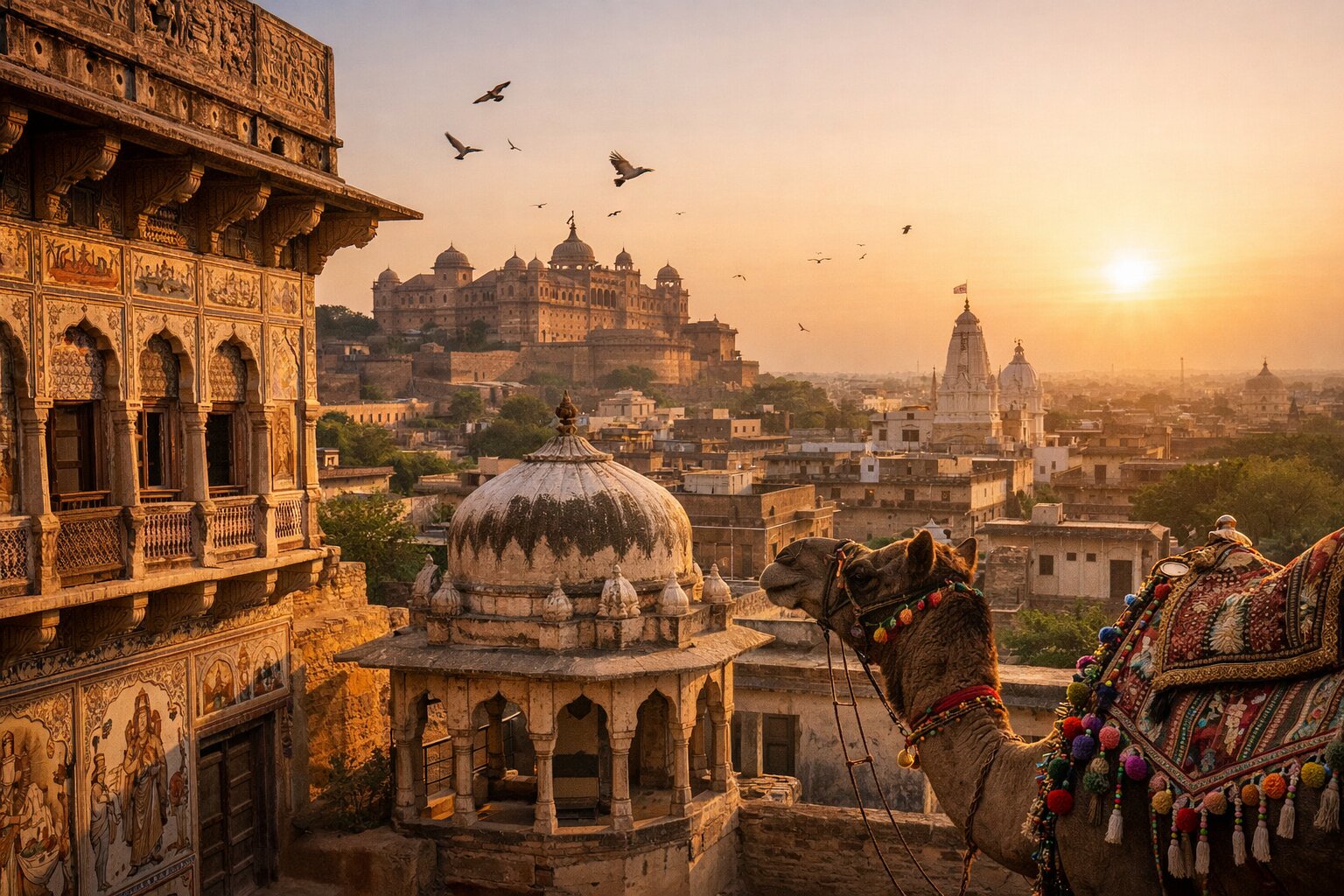
Nawalgarh is often described as a living museum, and it earns that title. History here isn’t behind glass cases or roped off in climate-controlled rooms. It lines the streets. It wraps around doorways. It looks down from ceilings you walk under without thinking twice.
Visitors can explore the restored Podar and Morarka haveli museums, wander through the old bazaar area where unrestored havelis still carry faded frescoes, and see how centuries of artistic tradition live on in the town’s architecture.
The Shekhawati festival, held each February, brings guided tours, handicraft exhibitions, and cultural performances to the region, adding a seasonal pulse to the heritage landscape.
For those who want to go deeper, staying inside a restored haveli is the most immersive way to experience Nawalgarh. Sleeping in rooms surrounded by original frescoes, eating in courtyards designed two centuries ago, and waking up to the same light that once fell on merchant families counting their fortunes. That’s something no museum ticket can replicate.
The Legacy of Nawalgarh
The story of Nawalgarh is not just about dates and rulers. It’s about what happens when trade, ambition, and artistic pride converge in one small place.
A Rajput thakur saw potential in a dusty village and built a planned town. Merchants arrived, grew wealthy, and poured their fortunes into walls. Artists turned those walls into canvases. And when the merchants left, the art stayed behind, waiting quietly for the world to notice.
Nawalgarh stands as proof that commerce and creativity are not separate forces. In the right conditions, they feed each other. The havelis here were built to impress neighbours and display status, yes. But they also preserved a visual record of a society in transition: one foot in mythology, one foot in modernity, and both painted in vivid colour.
For travellers looking to understand Rajasthan beyond its forts and palaces, Nawalgarh offers something more intimate. A story painted, quite literally, on its walls.
Stay in Shekhawati
Experience Nawalgarh From the Inside
Two restored 19th-century havelis. One unforgettable journey through Shekhawati.
Nawalgarh
Vivaana Museum Hotel
Jaipuria Haveli, Nawalgarh
A beautifully restored haveli in the heart of town. Home to the Shekha Museum, rooftop pool, and authentic Rajasthani dining.
Mandawa
Vivaana Culture Hotel
Churi Ajitgarh, Mandawa
A 150-year-old twin haveli with original frescoes, curated cultural experiences, and the warmth of Shekhawati hospitality.
Frequently Asked Questions
Who founded Nawalgarh and when was it established?
Nawalgarh was founded in 1737 by Thakur Nawal Singh Ji Bahadur of the Shekhawat Rajput clan. He built the town on the site of an earlier village called Rohili, which he received as a land grant from his father, Maharao Shardul Singh of Jhunjhunu. The town was named after its founder.
Why is Nawalgarh called the artistic capital of Shekhawati?
Nawalgarh holds nearly 200 fresco-adorned havelis, one of the highest concentrations in the Shekhawati region. The combination of merchant wealth, artistic patronage, and competitive building between families produced an exceptional density of painted mansions within a compact, walkable town.
What is the Podar Haveli Museum in Nawalgarh known for?
The Podar Haveli Museum, built in 1902, is Nawalgarh’s most visited attraction. It contains over 750 frescoes depicting Hindu mythology, daily life, and modern inventions like steam trains and early automobiles. The museum also houses 19 thematic galleries showcasing Rajasthani culture, from traditional costumes to musical instruments.
What happened to Nawalgarh’s merchant families?
By the late 19th and early 20th centuries, most Marwari merchant families migrated to larger cities like Mumbai, Kolkata, and Delhi. British trade policies and the development of port cities shifted commercial activity away from inland Shekhawati. The families left behind their grand havelis, many of which fell into disrepair over time.
Where can you stay inside a restored haveli in Nawalgarh?
Several heritage havelis in Nawalgarh and the broader Shekhawati region have been restored into boutique hotels. Vivaana Museum Hotel in Nawalgarh is a restored Jaipuria Haveli with an on-site museum, rooftop pool, and rooms surrounded by original frescoes. In nearby Mandawa, the Vivaana Culture Hotel offers a similar heritage experience inside a 150-year-old twin haveli.